Tannery Wastewater Treatment Technologies
Product Details
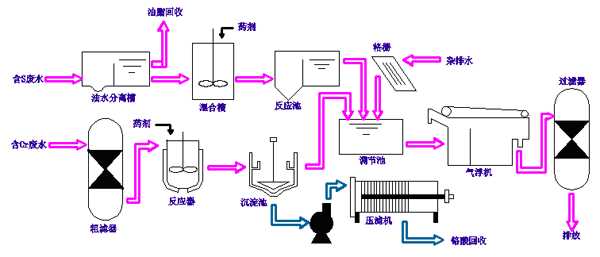
Sulphide wastewater: Following MnSO₄-catalysed oxidation, a desulphurisation aid is added and the pH is adjusted to neutral. After precipitation, the removal rates for CODcr and BOD₅ are 70–80%, whilst the removal rate for sulphides exceeds 97%.
Chrome tanning wastewater: The pH is adjusted to 8–8.5 to precipitate chromium in the Cr⁶⁺ form. The removal rate for CODcr is approximately 90%, for BOD₅ approximately 75%, and for chromium over 99.95%. The chromium sludge can be reused after filter press treatment.
Process features:
(1) Fully automated operation is possible, reducing the need for operational staff.
(2) The entire treatment process produces no secondary pollution.
(3) Comprehensive recovery technology is employed, resulting in high recovery rates for fats and oils and chromic acid, with excellent resource recovery benefits.
Related Products
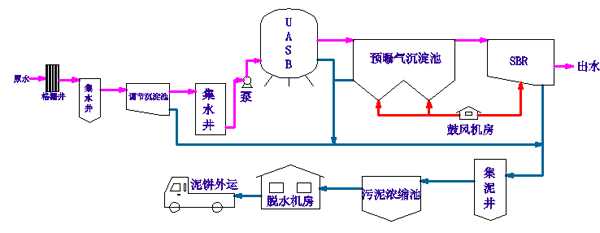
Starch wastewater treatment technology Product Details Technical Highlights: This process employs an anaerobic-aerobic biological treatment method for high-concentration organic wastewater. The anaerobic treatment unit utilises the UASB (Upflow Anaerobic Sludge Blanket) process, whilst the aerobic treatment employs the SBR (Sequencing Batch Reactor) process. Following anaerobic treatment, the refractory CODCr in the wastewater is converted into…
Textile Dyeing and Printing Wastewater Treatment Technologies Product Details Technical Key Points: (1) Utilise the anaerobic hydrolysis and acidification stage to alter molecular structures, thereby creating favourable conditions for aerobic treatment. (2) Sludge recirculation maintains high sludge concentration, whilst the anaerobic tank is utilised to digest the sludge. (3) Hydraulic pulsed distribution is employed for…
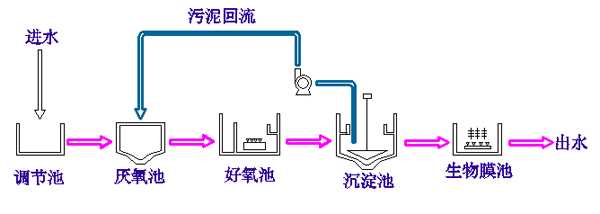
Membrane Bioreactor (MBR) Technology for the Treatment and Reuse of Domestic Wastewater Product Details The Membrane Bioreactor (MBR) process represents an organic integration of biological wastewater treatment technology and membrane separation technology. After biological treatment within the reactor has broken down and converted organic pollutants, microfiltration (MF) or ultrafiltration (UF) membranes are used to separate…
Desulphurisation wastewater treatment system Product Details The flue gas desulphurisation (FGD) wastewater treatment system is designed using optimised principles and methods; it is characterised by high efficiency, low operating costs and low energy consumption, and is widely used in the treatment of FGD wastewater at power stations. Related Products
Municipal wastewater treatment Product Details The Water Treatment Division of Haihui Group employs a team of technical specialists with many years’ experience in the treatment of industrial, domestic and municipal wastewater. The division maintains strong collaborative relationships with the Shandong Provincial Environmental Science Research and Design Institute, the School of Environmental Engineering at Tianjin University,…
Anaerobic internal circulation (HZIC) reactor Product Details Introduction to the HZIC Anaerobic Reactor The HZIC anaerobic reactor is a third-generation anaerobic reactor developed on the basis of research into Upflow Anaerobic Sludge Bed (UASB) reactors. It utilises a two-stage, three-phase separator to divide the reactor into a high-load zone at the bottom and a low-load…

处理生活污水回用技术.gif)