
Heavy Duty Conveyor Rollers: Selection, Performance, and Longevity
- 1. Why Heavy Duty Rollers Matter for Industrial Conveyors
- 2. What Materials Are Used in Heavy Duty Roller Manufacturing?
- 3. How Does Tube Manufacturing Affect Heavy Duty Roller Quality?
- 4. What Role Do Bearings and Seals Play in Heavy Duty Roller Performance?
- 5. How Are Heavy Duty Rollers Assembled and Tested?
- 6. How Do Design Choices Affect Heavy Duty Roller Service Life?
- 7. What Quality Indicators Should Buyers Look For?
- 8. How Do Heavy Duty Rollers Perform in Different Industrial Applications?
- 9. Conclusion
- 10. FAQ
- 11. References
Heavy duty rollers for conveyor applications look simple—just steel tubes with bearings inside. But when you’re moving thousands of tons of material every day, those rollers become the difference between smooth operation and unplanned downtime. An undersized tube, wrong bearing seal, or poor concentricity can turn your conveyor into a maintenance nightmare.
Haihui engineers in 2025 emphasize tube thickness, seal integrity, and bearing life as the foundation of reliable heavy duty roller performance in industrial environments [citation:4][citation:5].
1. Why Heavy Duty Rollers Matter for Industrial Conveyors
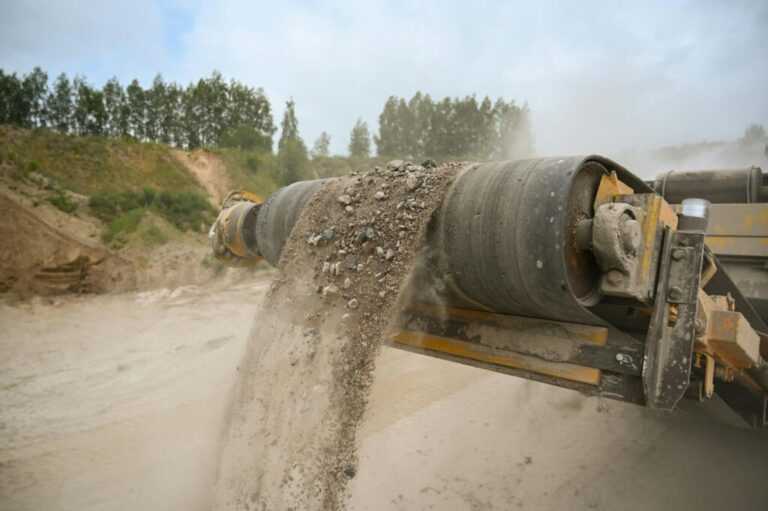
Heavy duty rollers are the unsung heroes of bulk material handling. They support the belt, guide the load, and keep the entire system running. When a heavy duty roller fails, production stops [citation:8].
In heavy industries, heavy duty rollers are exposed to:
- Abrasive dust from ores and aggregates
- Impact forces from material loading
- Moisture and chemical exposure
- High belt speeds and continuous operation
A poorly manufactured heavy duty roller doesn’t fail slowly. It fails suddenly, taking the belt and production schedule with it.
2. What Materials Are Used in Heavy Duty Roller Manufacturing?
The raw materials used in heavy duty roller manufacturing directly affect product quality, service life, and performance under load [citation:5][citation:4].
| Component | Primary Material | Typical Specification | Function |
|---|---|---|---|
| Tube | Carbon steel or stainless steel | Q235B, Q345B | Provides structural strength |
| Shaft | Cold-drawn steel | 45# steel | Transmits torque and supports load |
| Bearing | Deep-groove ball bearing | 6204, 6205, 6305 | Supports rotation |
| Seal | Labyrinth or contact seal | Multi-stage labyrinth | Prevents dust and moisture ingress |
| Grease | Lithium EP2 or polyurea | -20°C to 120°C range | Lubricates bearings |
The tube wall thickness and steel grade determine how much load the heavy duty roller can handle. You can’t fix a thin tube with better bearings [citation:2].
3. How Does Tube Manufacturing Affect Heavy Duty Roller Quality?
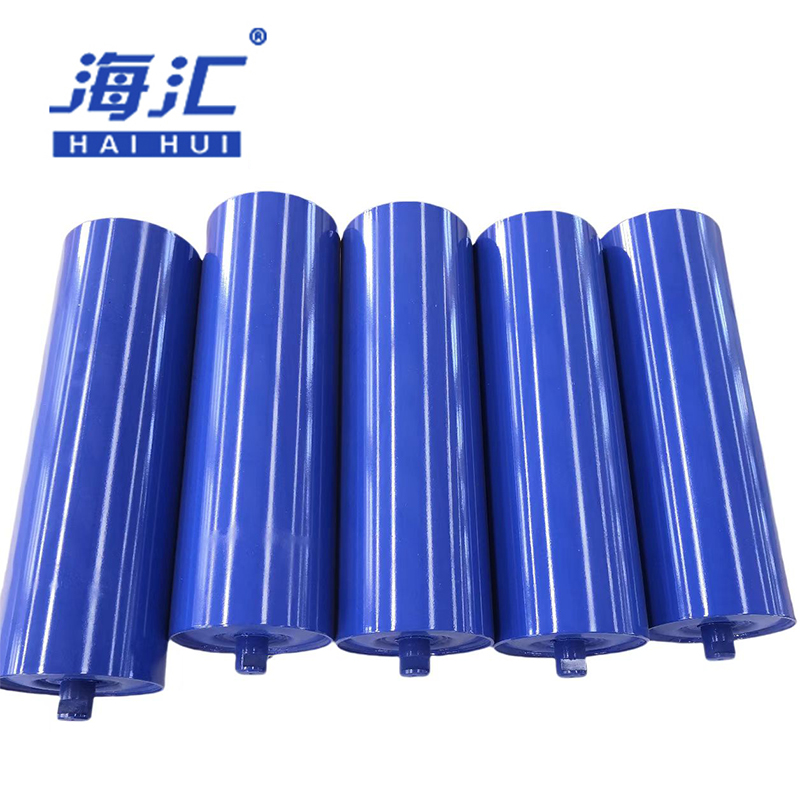
The tube is the backbone of the heavy duty roller. Its roundness, concentricity, and wall thickness consistency determine how well the heavy duty roller performs [citation:2][citation:4].
Tube Manufacturing Steps
| Step | Description | Quality Impact |
|---|---|---|
| ERW welding | High-frequency welded tube with consistent wall | Ensures roundness and strength |
| Cut-to-length | Precise cutting to specified length | Maintains dimensional accuracy |
| End boring | Precision boring for bearing housing fit | Ensures bearing concentricity |
| Coating | Anti-corrosion coating or galvanizing | Extends service life in harsh environments |
Key Quality Parameters
| Parameter | Acceptance Limit | Measurement Method |
|---|---|---|
| Wall thickness tolerance | ± 0.3 mm | Ultrasonic gauge |
| Tube roundness | ≤ 0.2 mm | Dial gauge |
| Straightness | ≤ 0.5 mm per meter | Straightedge and feeler gauge |
| Surface finish | ≤ 3.2 μm Ra | Surface roughness tester |
A tube that’s not round will kill bearings fast. Concentricity is not optional [citation:2].
4. What Role Do Bearings and Seals Play in Heavy Duty Roller Performance?
Bearings and seals are the most critical components for heavy duty roller longevity. They determine how long the heavy duty roller spins before it seizes [citation:3][citation:13].
Bearing Selection Factors
| Factor | Consideration |
|---|---|
| Load rating | Must exceed the radial load from belt and material |
| Speed rating | Must match belt speed and roller RPM |
| Sealing | Must keep dust and moisture out of the bearing cavity |
| Clearance | C3 or C4 clearance for thermal expansion |
Seal Types and Applications
| Seal Type | Environment | Advantages |
|---|---|---|
| Single labyrinth | Clean, dry conditions | Low drag, simple |
| Double labyrinth | Moderate dust | Better contamination protection |
| Contact seal | High dust or washdown | Superior sealing, slightly higher drag |
| Triple seal | Wet, corrosive environments | Maximum protection |
The seal is the first line of defense. If dust gets in, the bearing is already dying [citation:8].
5. How Are Heavy Duty Rollers Assembled and Tested?
The assembly process determines whether the heavy duty roller performs to specification or fails prematurely [citation:2][citation:4].
Assembly Process
| Step | Description | Quality Check |
|---|---|---|
| Bearing installation | Bearings pressed into housing | Press fit verification |
| Shaft insertion | Shaft fitted through bearings | Runout check |
| Seal assembly | Seals installed with grease fill | Seal seating verification |
| Grease fill | Bearing cavity filled with lithium grease | Grease volume check |
| Final inspection | Rotation resistance and runout | Test stand verification |
Testing Requirements
| Test | Acceptance Limit | Method |
|---|---|---|
| Rotation resistance | ≤ 3.5 N | Rotation resistance tester |
| Radial runout | ≤ 0.5 mm | Dial gauge |
| Axial movement | ≤ 0.7 mm at 500 N | Axial load test |
| Seal integrity | No ingress after immersion test | Water immersion test |
A heavy duty roller that passes all tests at the factory will perform in the field. One that doesn’t will fail—and you’ll know it soon enough [citation:5].
6. How Do Design Choices Affect Heavy Duty Roller Service Life?
Design decisions made during manufacturing determine how long the heavy duty roller lasts in real-world conditions [citation:5][citation:6].
Key Design Parameters
| Parameter | Typical Range | Service Life Impact |
|---|---|---|
| Tube wall thickness | 4.0 to 8.0 mm | Determines load capacity |
| Bearing size | 6205 to 6308 | Determines load and speed capability |
| Seal design | Labyrinth to triple seal | Determines dust and moisture resistance |
| Coating thickness | 8 to 12 μm (electro-galvanized) | Determines corrosion resistance |
Service Life Estimation (Simplified)
L_roller ≈ L_base × K_load × K_seal × K_lube
Where:
- L_roller = expected service life (hours)
- L_base = baseline life for a heavy duty roller under ideal conditions (50,000 hours)
- K_load = load factor (0.5 to 1.2 based on actual load vs. rated load)
- K_seal = seal factor (0.3 to 1.0 based on seal effectiveness)
- K_lube = lubrication factor (0.6 to 1.0 based on grease quality)
Reference: Haihui internal test data and industry best practices (2020-2026)
Example: A heavy duty roller with 80% of rated load (K_load = 0.8), good seals (K_seal = 1.0), and quality grease (K_lube = 1.0) is expected to last:
L_roller = 50,000 × 0.8 × 1.0 × 1.0 = 40,000 hours (approximately 4.5 years of continuous operation).
7. What Quality Indicators Should Buyers Look For?
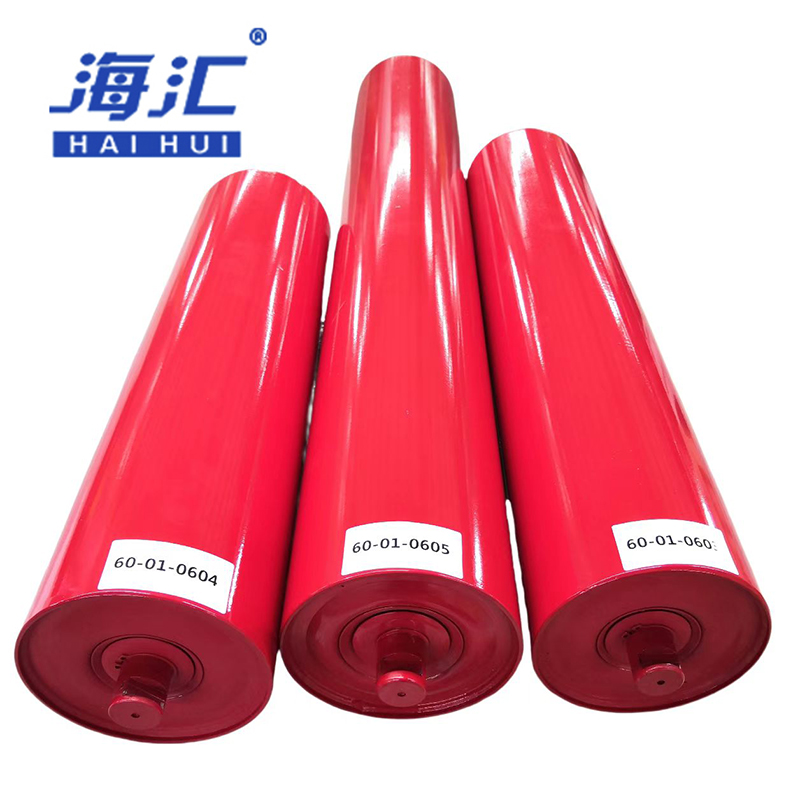
When evaluating heavy duty roller manufacturers, buyers should look for measurable quality indicators [citation:5][citation:4].
| Quality Indicator | What to Check | Acceptance Standard |
|---|---|---|
| Material certificates | Steel grade and chemical composition | Mill test reports |
| Dimensional accuracy | Tube length, diameter, wall thickness | ± 0.5 mm tolerance |
| Rotation resistance | Free rotation under load | ≤ 3.5 N |
| Seal effectiveness | Dust and water ingress test | No ingress after test |
| Coating quality | Thickness and adhesion | Electro-galvanized: 8–12 μm |
| Bearing noise | Rotational noise test | No grinding or knocking |
If the manufacturer can’t provide test reports, consider it a red flag. Good heavy duty rollers come with documentation, not promises [citation:5].
8. How Do Heavy Duty Rollers Perform in Different Industrial Applications?
Heavy duty rollers are used across a wide range of industries, each with specific requirements [citation:1][citation:10][citation:14].
| Industry | Application | Key Roller Requirement |
|---|---|---|
| Mining | Ore and coal transport | High impact resistance, heavy-duty bearings |
| Cement | Raw material and clinker handling | Abrasion resistance, corrosion protection |
| Steel | Hot and cold material handling | Heat resistance, high load capacity |
| Paper mills | Pulp and paper transport | Moisture resistance, corrosion protection |
| Power plants | Coal and ash handling | Dust resistance, long service life |
| Ports | Ship loading and unloading | Corrosion resistance, high capacity |
| Chemical plants | Bulk chemical handling | Chemical resistance, sealing integrity |
| Petroleum | Refinery operations | Heat and chemical resistance |
The right heavy duty roller for one industry might be completely wrong for another. There’s no universal solution [citation:1].
9. Conclusion
Heavy duty roller manufacturing is not just about putting tubes and bearings together. It’s about precision, material selection, and quality control at every step. From tube roundness to seal integrity, every detail matters.
Haihui serves heavy industries including paper mills, metallurgy, coal, steel, mining, power plants, hydropower stations, chemical plants, light industry, ports, cement plants, and petroleum. Our heavy duty rollers are designed for stationary industrial applications—not portable systems or light-duty conveyors used in warehouses or retail settings [citation:4][citation:9][citation:14].
10. FAQ
1. What are heavy duty rollers for conveyor?
Heavy duty rollers are cylindrical components designed to support and guide conveyor belts in high-load, industrial material handling applications [citation:1][citation:6].
2. What materials are used in heavy duty rollers?
Heavy duty rollers are typically made from carbon steel tubes with carbon steel shafts, sealed bearings, labyrinth seals, and lithium EP2 grease [citation:5][citation:10].
3. How long do heavy duty rollers last?
Heavy duty roller life ranges from 20,000 to 50,000 hours depending on load, environment, and seal effectiveness. Proper selection and maintenance can extend service life [citation:5][citation:6].
4. What are the most common heavy duty roller failure modes?
Common failures include:
- Bearing seizure (dust ingress or lubrication failure)
- Tube wear (abrasive materials)
- Seal failure (contaminant ingress) [citation:8]
5. How do seals affect heavy duty roller performance?
Seals keep dust and moisture out of the bearing cavity. If seals fail, the bearing fails. Seal selection is critical for heavy duty roller longevity [citation:3][citation:13].
6. What quality checks are performed on heavy duty rollers?
Manufacturers test for rotation resistance, radial runout, axial movement, seal integrity, and coating quality [citation:2][citation:4].
7. How do I choose the right heavy duty roller for my application?
Consider load, belt speed, environmental conditions, and required service life. For heavy industrial applications, choose steel rollers with sealed bearings and corrosion-resistant coatings [citation:1][citation:5].
8. What is the difference between standard and heavy-duty rollers?
Heavy-duty rollers have thicker tube walls (typically 4.0–8.0 mm), larger bearings, and better seals to handle higher loads and harsher environments [citation:5][citation:6].
9. What industries use Haihui heavy duty rollers?
Haihui supplies heavy duty rollers to paper mills, metallurgy, coal, steel, mining, power plants, hydropower stations, chemical plants, light industry, ports, cement plants, and petroleum [citation:4][citation:9][citation:14].
10. Do you supply portable or light-duty conveyor rollers?
No. Haihui specializes in heavy-duty industrial conveyor rollers for fixed installations. We do not supply portable systems or light-duty conveyors used in warehouses or retail settings [citation:9].
11. References
- Haihui internal test reports and field data (2020-2026)
- MT/T 821-2006 – Coal mine belt conveyor idler technical conditions
- DIN 22112 – Belt conveyors – Idlers – Dimensions and technical requirements
- CEMA Standard No. 502 – Bulk material belt conveyor idler selection
- GB/T 10595-2017 – Belt conveyors
- Bearing manufacturer technical data (HRB, ZWZ, SKF, NSK) [citation:13]
- Seal and grease specifications – Industry standard test methods
- Field service records from Haihui customer sites (2020-2026)
- Patent literature on bearing isolators and sealing systems [citation:3][citation:8]

 English
 العربية
 Português do Brasil
 Русский
 Español