
How to Choose the Right Conveyor Tail Pulley for Your Belt System
- Harmonious Highlights for Conveyor Tail Pulleys
- Solid Steel Drum Tail Pulley
- Wing Tail Pulley for Sticky Materials
- Self-Aligning Tail Pulley for Mistracking Conveyors
- Diameter Sized for Belt Fatigue, Not Just Space
- Lagging Compound Matched to Site Conditions
- Bearing Arrangement and Take-Up Integration
- Correct Diameter Selection for Belt Life
- Lagging That Protects Without Damaging the Belt
- Bearing Life in Harsh Environments
- Weld Quality and Stress Relief
- Field-Replaceable Lagging for Maintenance Flexibility
- Heavy-Duty Mining and Aggregate Drives
- Cement and Clinker Handling
- Port and Ship Loading Terminals
- Power Plants and Coal Handling
A conveyor tail pulley isn’t just a wheel at the back of the conveyor. It’s the component that keeps the belt tracking straight at the loading end, maintains tension on short systems, and protects the belt from unnecessary fatigue. When it’s undersized, misaligned, or built with the wrong lagging, the belt starts wandering, edges fray, material spills, and maintenance crews spend their shifts fixing problems instead of preventing them.
Old-school thinking treats the conveyor tail pulley as a passive part—something to buy cheap and replace often. But modern bulk handling demands better. Abrasive ores, wet cement, sticky fertilizers, and high-tonnage port operations all place demands on the tail pulley that a low-spec unit simply can’t survive.
Haihui engineers emphasize belt-friendly diameter selection, lagging matched to site conditions, and take-up integration as the baseline for dependable conveyor tail pulley performance. Drawing on our experience manufacturing welded steel drum pulleys for bulk material handling across cement, power, mining, port, and steel industries, we build tail pulleys that keep belts running straight and smooth.
Harmonious Highlights for Conveyor Tail Pulleys
➔ Diameter Logic: Size the conveyor tail pulley to the belt carcass and splice type—too small accelerates belt fatigue; too large wastes space and cost.
➔ Lagging Selection: Choose rubber, ceramic, or FRAS compounds based on wet, abrasive, or fire-risk conditions to prevent slip and protect the shell.
➔ Bearing & Take-Up Integration: Match bearing type, sealing, and take-up mechanism to the tension requirements and environmental conditions of the conveyor.
➔ Tracking Support: Specify crowned or flat face geometry, and consider self-aligning features where belt wander is a recurring problem.
Which Conveyor Tail Pulley Configurations Boost Conveyor Reliability?
Great conveying starts at the loading end. In the world of custom conveyor tail pulleys, configuration quietly shapes belt training, tension control, and maintenance frequency. From solid drum pulleys to self-aligning designs, smart tail pulley selection turns raw belt tension into years of steady material flow.
Solid Steel Drum Tail Pulley
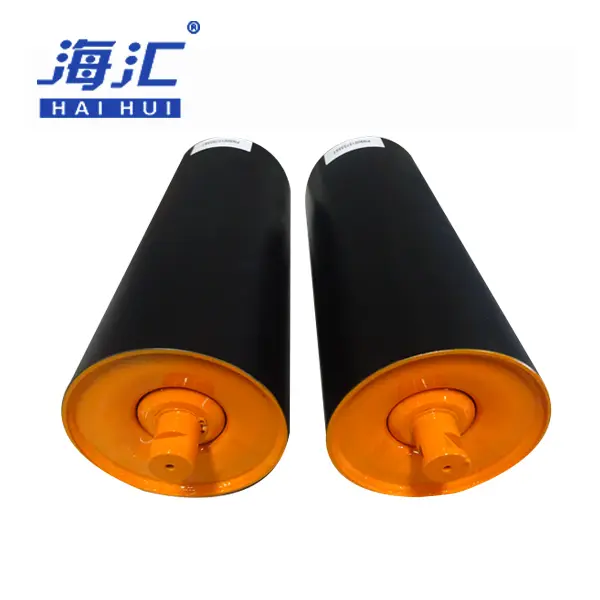
The solid steel drum tail pulley is the standard workhorse of bulk handling. A rolled steel shell, machined end discs, and a cold-drawn or forged shaft are welded into a rigid unit. The smooth shell surface gives the belt a stable path at the loading end.
Key performance layers:
- Shell stiffness under belt tension
- Weld integrity at end disc connections
- Shaft deflection control at bearing seats
Production flow typically follows:
- Shell rolling and longitudinal seam welding
- End disc machining and fitting
- Circumferential welding and stress relief
- Lagging application and dynamic balancing
Performance comparison across tail pulley types:
| Configuration | Typical Belt Width (mm) | Lagging Flexibility | Self-Cleaning | Best For |
|---|---|---|---|---|
| Solid Drum (plain) | 400–2400 | High | Low | Standard loading points, dry materials |
| Solid Drum (lagged) | 400–2400 | High | Medium | Wet or slippery conditions |
| Wing Pulley | 400–1800 | Low | High | Sticky, fibrous materials |
| Spiral-Wrapped | 600–2000 | Medium | High | Higher-speed self-cleaning applications |
| Self-Aligning | 800–2400 | Medium | Low | Conveyors prone to belt mistracking |
For operations handling abrasive ores or cement clinker, a lagged solid drum conveyor tail pulley from Haihui combines shell thickness options from 6 mm to 25 mm with lagging compounds matched to the material. Partnering with a manufacturer that controls welding, machining, and lagging in-house keeps tolerances tight and delivery predictable.
Wing Tail Pulley for Sticky Materials
A wing tail pulley uses steel bars or fins welded to the shaft instead of a solid shell. Material falls through the gaps, so buildup sheds naturally. That makes it a practical choice when the belt carries wet, sticky, or fibrous loads.
Key advantages:
- Self-cleaning action reduces carryback
- Lower rotating mass than solid drum equivalents
- Simple field inspection without removing the belt
In practical conveyor design:
- The wing structure supports the belt but doesn’t trap material.
- Gaps allow fines and moisture to drop away.
- The open design suits loading and return positions on challenging belts.
Many aggregate and recycling operations choose wing tail pulleys when carryback is a chronic problem. However, wing pulleys introduce oscillating action to the belt path and can destabilize belt sealing systems. CEMA advises against wing pulleys on belts traveling over 225 m/min (450 ft/min). Larger lumps can lodge in the wings, potentially causing the damage the design is meant to prevent.
A superior alternative is the spiral-wrapped tail pulley, which adds a steel strip spirally wrapped around the circumference to cover the wings. This maintains the self-cleaning function while eliminating belt bounce.
Self-Aligning Tail Pulley for Mistracking Conveyors
A self-aligning conveyor tail pulley pivots about a vertical axis to maintain belt tracking. When the belt drifts, a sensor detects the deviation and an actuator pivots the pulley support to increase tension on the side where the belt has drifted, steering it back to center.
Why operators choose it:
- Automatic correction of belt mistracking
- Reduced edge damage and spillage
- Lower maintenance intervention
Practical notes:
- Requires a control system and actuator
- Best suited for conveyors with recurring mistracking problems
- More complex than a fixed tail pulley, but reduces long-term belt damage
For conveyors handling variable loads or operating in challenging alignment conditions, a self-aligning tail pulley can pay for itself by extending belt life.
3 Key Features in Conveyor Tail Pulley Engineering
A conveyor tail pulley that causes belt damage isn’t a pulley problem—it’s a design and manufacturing problem. When specifying a custom tail pulley, the engineering details determine whether the unit delivers years of smooth belt travel or months of frustration.
Diameter Sized for Belt Fatigue, Not Just Space
The conveyor tail pulley diameter directly affects belt bending stress and splice fatigue. A pulley that’s too small for the belt carcass causes delamination of belt layers and laceration of the reinforcing fabric.
Minimum tail pulley diameter recommendations based on belt type:
| Belt Type | Belt Tension (%) | Minimum Tail Pulley Diameter (mm) | Snub/Bend Pulley (mm) |
|---|---|---|---|
| Textile belt (light duty) | < 30% | 125 | 100 |
| Textile belt (standard) | < 50% | 200 | 160 |
| Textile belt (heavy duty) | > 60% | 250 | 200 |
| EP multi-ply | > 60% | 400 | 315 |
| Steel cord | > 60% | 500 | 400 |
For high-tension applications, a larger conveyor tail pulley diameter increases belt service life. The weaker the surface pressure on the pulley, the better the belt/pulley adhesion coefficient becomes. Never undersize a tail pulley to save space—the belt will pay for it.
Lagging Compound Matched to Site Conditions
Lagging on a tail pulley serves two purposes: protecting the shell from wear and improving belt tracking. Unlike drive pulleys, tail pulleys don’t need maximum friction for torque transmission, but they do need enough grip to keep the belt centered.
Lagging selection by condition:
| Condition | Recommended Lagging | Pattern | Notes |
|---|---|---|---|
| Dry, clean, general bulk | Rubber | Plain or diamond | Standard choice |
| Wet, muddy, outdoor | Rubber | Herringbone | Directional; channels water |
| High abrasion, sharp ore | Abrasion-resistant rubber | Plain or grooved | Protects shell |
| Reversing conveyor | Rubber | Diamond | Non-directional |
| Fire-risk underground | FRAS compound | Plain or grooved | Safety requirement |
| Low-power, narrow belt | Smooth steel | None | Cost-effective for light duty |
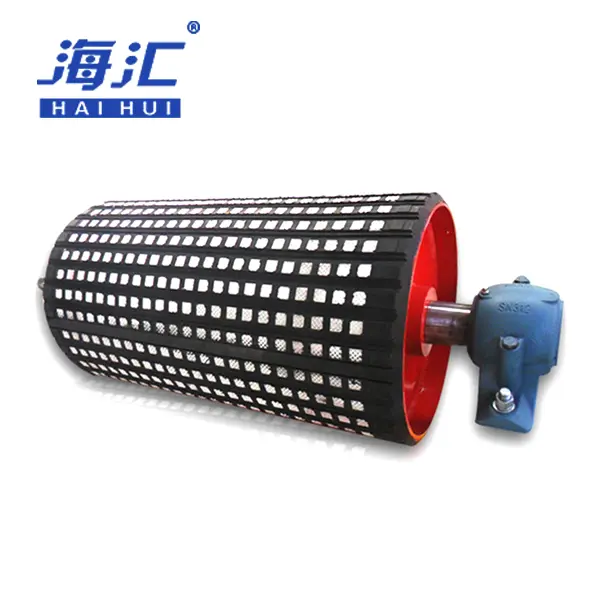
Smooth steel tail pulleys suit conveyors with low power requirements and narrow belt widths. Herringbone rubber lagging offers excellent friction factor, anti-slip, and drainage ability. Diamond rubber lagging works for two-way operating conveyors.
Bearing Arrangement and Take-Up Integration
The tail pulley often serves as the take-up point on shorter conveyors. The take-up mechanism determines how belt tension is maintained and how the pulley is adjusted.
Take-up type comparison:
| Take-Up Type | Adjustment Method | Best For | Notes |
|---|---|---|---|
| Fixed | No adjustment; belt tension set by design | Short conveyors with stable load | Simplest; no field adjustment |
| Screw take-up | Manual adjustment via threaded rods | Short to medium conveyors | Requires periodic inspection |
| Gravity take-up | Automatic tension via weighted counterweight | Long conveyors, variable loads | Self-adjusting; needs space |
Bearing arrangement options:
| Bearing Arrangement | Vantagens | Disadvantages | Best For |
|---|---|---|---|
| External bearings | Easy access for lubrication and replacement | Exposed to dust and moisture | Standard industrial conveyors |
| Internal bearings | Protected from environment; compact | Harder to inspect; requires pulley removal for service | Washdown, corrosive, or space-limited |
For dusty environments like cement plants or coal handling, external bearings with labyrinth seals are common. For washdown or corrosive applications, internal bearings with contact seals may be preferred.
5 Operational Hooks for Conveyor Tail Pulleys That Prevent Downtime
A conveyor tail pulley that fails takes the whole conveyor with it. The difference between a pulley that lasts and one that doesn’t often comes down to whether the specification matched the site’s real conditions—not the catalog conditions.
Correct Diameter Selection for Belt Life
Steady-state tension is rarely the limiting case. The belt sees its highest bending stress as it wraps around the tail pulley. If the pulley is undersized, the belt’s carcass fatigues faster than it should.
Practical check:
- Confirm belt carcass material (textile, EP, steel cord)
- Apply the minimum diameter recommendation for that belt type
- Verify splice type compatibility with the selected diameter
- Check that the pulley face width matches the belt width
Signs of undersized tail pulley:
- Belt cracking or delamination near the splice
- Visible belt edge damage at the loading end
- Shortened belt service life compared to expectations
Lagging That Protects Without Damaging the Belt
Lagging must provide enough grip to keep the belt centered without being so aggressive that it chews the belt cover. The balance depends on belt type, tension ratio, and environmental conditions.
Guidelines:
- For clean, dry applications, plain rubber lagging is usually sufficient.
- For wet or muddy conditions, herringbone grooved rubber improves water drainage.
- For reversing conveyors, use diamond pattern; herringbone is directional and unsuitable.
- For fire-risk underground applications, FRAS lagging is mandatory.
Belt cover protection: Ceramic lagging is generally not required on tail pulleys because they don’t transmit drive torque. A softer rubber compound is usually sufficient and gentler on the belt.
Bearing Life in Harsh Environments
Bearings fail when contaminants enter, lubrication degrades, or loads exceed capacity. In cement, mining, and port environments, all three risks are present.
Protection strategy:
- Sealing: Multi-stage labyrinth for dry dust; contact lip seals for wet or washdown conditions
- Housing: Machined fits, grease purge ports, and drain paths to prevent water pooling
- Lubrication: Lithium EP2 for general use; high-temperature or food-grade greases for special applications
- Monitoring: Vibration sensors or temperature probes on critical tail pulleys
Haihui manufactures pulley bearing housings with machined fits and provisions for standard sealing arrangements. For severe environments, we can supply stainless steel or coated housings.
Weld Quality and Stress Relief
The shell-to-end-disc weld is a high-stress joint. Poor penetration or lack of stress relief can lead to cracking under cyclic loading.
Quality checks:
- Weld procedure specification (WPS) for shell longitudinal and circumferential welds
- Non-destructive testing (NDT) on critical welds—ultrasonic or magnetic particle
- Post-weld stress relief for heavy-duty pulleys
- Dimensional inspection of shell roundness and end disc perpendicularity
A pulley with a cracked weld can fail suddenly, dropping the belt and potentially injuring personnel. Specifying NDT on critical welds is standard practice for tail pulleys in mining and heavy industry.
Field-Replaceable Lagging for Maintenance Flexibility
Even the best lagging wears out. Field-replaceable options reduce the time and cost of re-lagging.
Options:
- Slide lagging: Pre-formed lagging segments that slide onto the pulley face and lock in place; common for tight-access installations.
- Cold-bond lagging: Pre-cured rubber strips bonded to the pulley face on-site; suitable for emergency repairs but lower bond strength than hot vulcanization.
- Weld-on strip lagging: Steel-backed rubber strips welded to the pulley face; robust but requires welding.
For critical conveyors, maintaining a spare lagged pulley or a field-replaceable lagging kit can cut downtime from days to hours.
Which Conveyor Tail Pulley Specifications Suit Your Site?
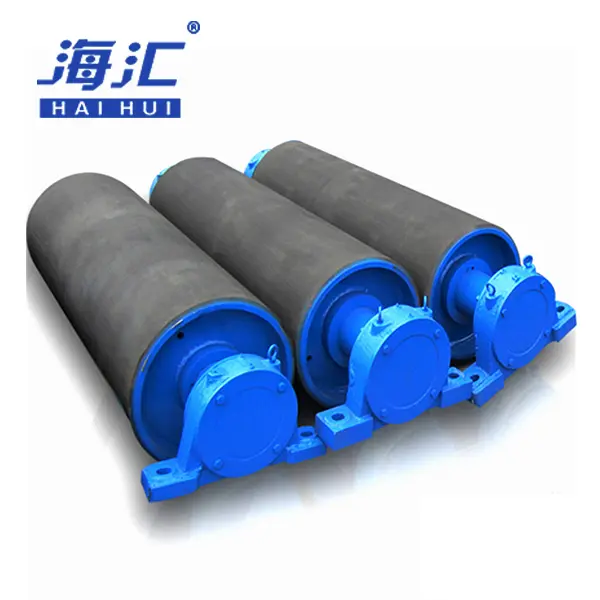
Choosing the right conveyor tail pulley comes down to matching diameter, lagging compound, and bearing protection to the actual operating conditions—not the ideal conditions on a datasheet.
Heavy-Duty Mining and Aggregate Drives
Mining conveyors face the worst combination: high tension, abrasive material, frequent starts, and remote locations where downtime is expensive.
Specification priorities:
- Shaft material: 42CrMo or EN19 for fatigue resistance
- Lagging: high-abrasion rubber, hot vulcanized
- Bearings: spherical roller, C3 clearance, labyrinth seals
- Shell: heavy-wall steel, NDT on welds
- Diameter: sized for steel cord belt if applicable
A tail pulley on a 1,200 mm belt carrying steel cord carcass demands a minimum diameter of 500 mm to avoid belt fatigue.
Cement and Clinker Handling
Cement plants run conveyors through dust, heat, and abrasive clinker. Tail pulleys must resist both wear and contamination.
Specification priorities:
- Lagging: abrasion-resistant rubber, 10–15 mm thick
- Bearings: sealed for life or regreasable with purge ports
- Housing: protected from dust ingress
- Shell: wear-resistant liner or thickened wall at the loading zone
Cement conveyors often run at moderate tension but high dust loads. Bearing sealing is the critical factor for long life.
Port and Ship Loading Terminals
Port conveyors handle high tonnage with variable loading and outdoor exposure. Salt air and rain add corrosion to the challenge.
Specification priorities:
- Lagging: herringbone or diamond grooved rubber for wet grip
- Shaft: EN19 or equivalent, sized for fatigue
- Housing: hot-dip galvanized or stainless steel options
- Bearings: sealed against moisture, with water-resistant grease
Port terminals often operate 24/7, so reliability and field-replaceable lagging are important.
Power Plants and Coal Handling
Coal conveyors combine dust, fire risk, and continuous operation. Safety and reliability are the top priorities.
Specification priorities:
- Lagging: FRAS compound for underground or enclosed galleries
- Bearings: sealed, with temperature monitoring
- Shaft: sized for stall torque
- Welds: NDT and stress relief
For above-ground coal handling, standard abrasion-resistant rubber lagging is typically sufficient. For enclosed or underground installations, FRAS lagging is mandatory in many jurisdictions.
Conveyor Tail Pulley Specifications at Haihui
Haihui Environmental Protection Equipment Co., Ltd. is a manufacturer of belt conveyor pulleys, rollers, and structural components based in Rizhao, Shandong, China. The company operates 12 intelligent production workshops with an annual output capacity of 15,000 sets of equipment and holds 168 authorized patents, including 15 invention patents.
Product scope: welded steel drum pulleys, wing pulleys, head pulleys, tail pulleys, bend pulleys, and complete pulley assemblies for belt conveyors. Belt widths from 400 mm to 2,400 mm; pulley diameters from 200 mm to 1,600 mm. Materials include Q235 carbon steel and custom alloy steels for high-tension applications.
Quality systems: ISO 9001 certified. Products are manufactured to CEMA, AS, DIN, ISO, and GB standards.
Export markets: Products are exported to the United States, Russia, Canada, Australia, South America, the Middle East, and Southeast Asia.
Service capability: Professional sales team with 24-hour response, sample delivery in 1–2 days, OEM customization for products, logos, and packaging, and small-quantity order acceptance for urgent requirements.
FAQ about Conveyor Tail Pulleys
Q: What is a conveyor tail pulley?
A: A conveyor tail pulley is the pulley located at the loading end of a belt conveyor. It redirects the belt back toward the drive pulley. On short conveyors, the tail pulley often serves as the take-up pulley, providing tension on the belt.
Q: What is the difference between a head pulley and a conveyor tail pulley?
A: The head pulley is at the discharge end and usually drives the belt. The tail pulley is at the loading end and redirects the belt. The head pulley is powered; the tail pulley is typically an idler pulley.
Q: What is the purpose of lagging on a conveyor tail pulley?
A: Lagging on a tail pulley protects the shell from wear and improves belt tracking. Unlike drive pulleys, tail pulleys don’t need maximum friction for torque transmission, but they do need enough grip to keep the belt centered.
Q: How do I choose the right lagging for my tail pulley?
A: Choose based on operating conditions. Smooth steel suits low-power, narrow-belt conveyors. Rubber lagging (herringbone or diamond) works for wet or abrasive conditions. FRAS lagging is required for fire-risk applications.
Q: What is the minimum tail pulley diameter for a given belt?
A: Minimum diameter depends on belt carcass material and thickness. For a standard textile belt with tension under 50%, a minimum tail pulley diameter of 200 mm is recommended. For heavy-duty EP belts over 60% tension, 400 mm is the minimum.
Q: Can a conveyor tail pulley serve as a take-up pulley?
A: Yes. On short conveyors, the tail pulley often serves as the take-up pulley, providing tension on the belt. Screw take-up or gravity take-up mechanisms can be integrated with the tail pulley.
Q: What is a self-aligning tail pulley?
A: A self-aligning tail pulley pivots about a vertical axis to maintain belt tracking. When the belt drifts, a sensor detects the deviation and an actuator pivots the pulley support to steer the belt back to center.
Q: When should I use a wing pulley instead of a solid tail pulley?
A: Wing pulleys suit sticky materials and spillage-prone areas. They are self-cleaning but introduce belt oscillation. CEMA advises against wing pulleys on belts over 225 m/min. A spiral-wrapped wing pulley is a better alternative for higher speeds.
Q: What is the typical service life of a conveyor tail pulley?
A: With proper specification and maintenance, a welded steel tail pulley can last 10–15 years. Lagging typically requires replacement every 2–5 years depending on material abrasiveness and operating conditions.
Q: Does Haihui manufacture conveyor tail pulleys for all conveyor applications?
A: Haihui manufactures conveyor tail pulleys for heavy-duty industrial conveyors in cement, mining, steel, power, port, chemical, and paper industries. We do not supply portable or light-duty conveyors used in warehouses or retail settings.
Referências
- CEMA Standard B105.1-2015 – Specifications for Welded Steel Conveyor Pulleys with Compression Type Hubs. Conveyor Equipment Manufacturers Association.
- CEMA – Pulley Lagging. Conveyor Equipment Manufacturers Association, Belt Book Chapter 8.
- Superior Industries – Conveyor Pulley Lagging: Materials, Patterns, and Applications.
- Martin Engineering – Wings Or Wraps [Tail Pulleys]? Wing pulley limitations, CEMA speed advisory, and spiral-wrapped alternative.
- Sempertrans – Minimum Diameter of Pulleys. Minimum diameter tables for textile belts, EP multi-ply, and steel cord belts based on tension.
- Haihui Environmental Protection Equipment Co., Ltd. – Conveyor tail pulley with hot vulcanized rubber lagging. Product specifications.
- US Patent 7866462 B2 – Belt Type Conveyor Apparatus with Adjustable Tail Pulley.
- Rizhao Daily – Haihui Environmental overseas orders grow, production capacity utilization exceeds 95%.
 English
 العربية
 Português do Brasil
 Русский
 Español