
Best Guide to Industrial Conveyor Equipment Performance Optimization
- Summer Construction Overview and Strategic Project Execution
- 1. Large-Scale Belt Conveyor Manufacturing and Site Installation
- 2. Chemical Park Wastewater Treatment System Integration
- 3. Ultra-Low Emission Dust Control Retrofits in Steel Manufacturing
- 4. Intelligent Conveyor Systems for Paper Manufacturing Facilities
- 5. Integrated Flue Gas Desulfurization and Dust Removal Systems
- 6. Local Industrial Dust Control and Global Equipment Delivery
- 7. Engineering Calculations for Conveyor Drive Power and Dust Collector Sizing
- 8. Frequently Asked Questions (FAQ)
- 9. References and Industry Standards
Summer Construction Overview and Strategic Project Execution
During peak summer heat, field construction teams across Haihui Environmental Protection projects maintain high operational velocity and strict schedule control. Manufacturing lines and installation sites are working concurrently across multiple sectors, including wastewater treatment, ultra-low emission retrofits, intelligent conveyor equipment manufacturing, and international order fulfillment. Engineering personnel are driving progress while adhering to stringent safety and quality management protocols.
                  [ Project Execution Fronts ]
                               │
   ┌───────────────────┬───────┴───────────┬───────────────────┐
   ▼                   ▼                   ▼                   ▼
[ Conveyor ]    [ Wastewater ]     [ Dust Control ]    [ Global Orders ]
  Systems         Treatment          Retrofits           Fulfillment
The company manages dual-track manufacturing and field erection across multiple provinces in China and global installation sites. Engineering crews coordinate equipment staging, structural assembly, and system commissioning to minimize operational downtime for heavy industrial clients.
1. Large-Scale Belt Conveyor Manufacturing and Site Installation
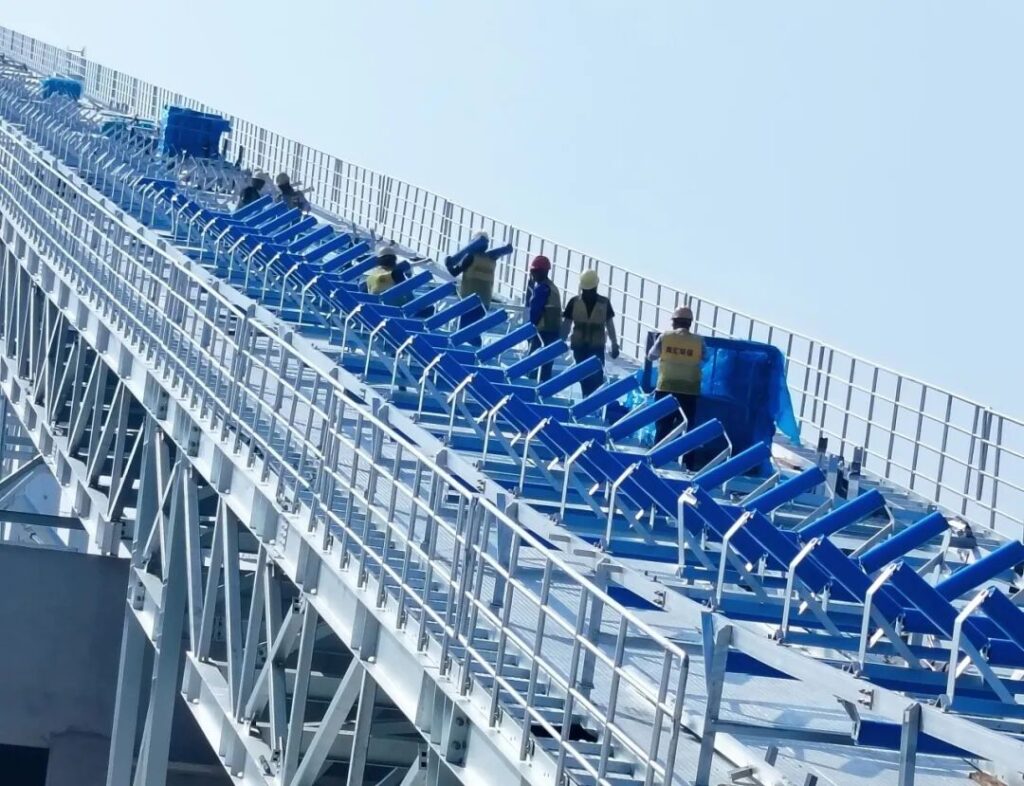
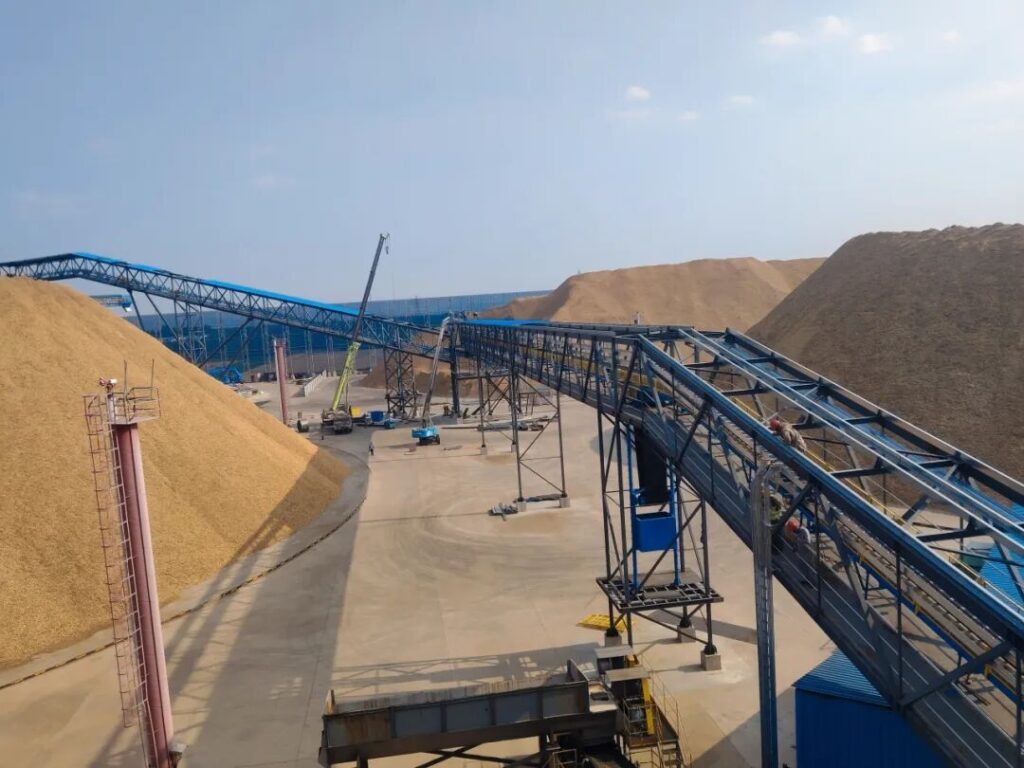
Haihui is executing concurrent conveyor installation projects across major industrial manufacturing hubs in Tianjin and Beihai, comprising 72 belt conveyor lines designed for heavy-duty material handling.
                    [ Dual-Site Execution Hub ]
                                 │
         ┌───────────────────────┴───────────────────────┐
         ▼                                               ▼
 [ Tianjin Plant ]                              [ Beihai Plant ]
 - 34 Belt Conveyors                            - 38 Belt Conveyors
 - Lines 1-8 Commissioned (20% Total)           - Structural Drawings Finalized
 - On-site Mechanical Installation              - Batch Production & Crew Staging
Tianjin Facility Operations
The Tianjin facility encompasses 34 conveyor lines. Mechanical crews are on-site performing structural leveling, idler frame alignment, and drive unit positioning. Conveyor lines 1 through 8 have completed mechanical assembly, electrical wiring, and preliminary no-load testing, achieving an overall project completion rate of 20%.
Beihai Facility Operations
Structural fabrication drawings for 38 belt conveyor lines at the Beihai facility are finalized. Manufacturing workshops are operating at full capacity to produce pulley assemblies, structural trusses, and take-up frames. Installation crews have mobilized to initiate base foundation alignment and structural steel erection.
2. Chemical Park Wastewater Treatment System Integration
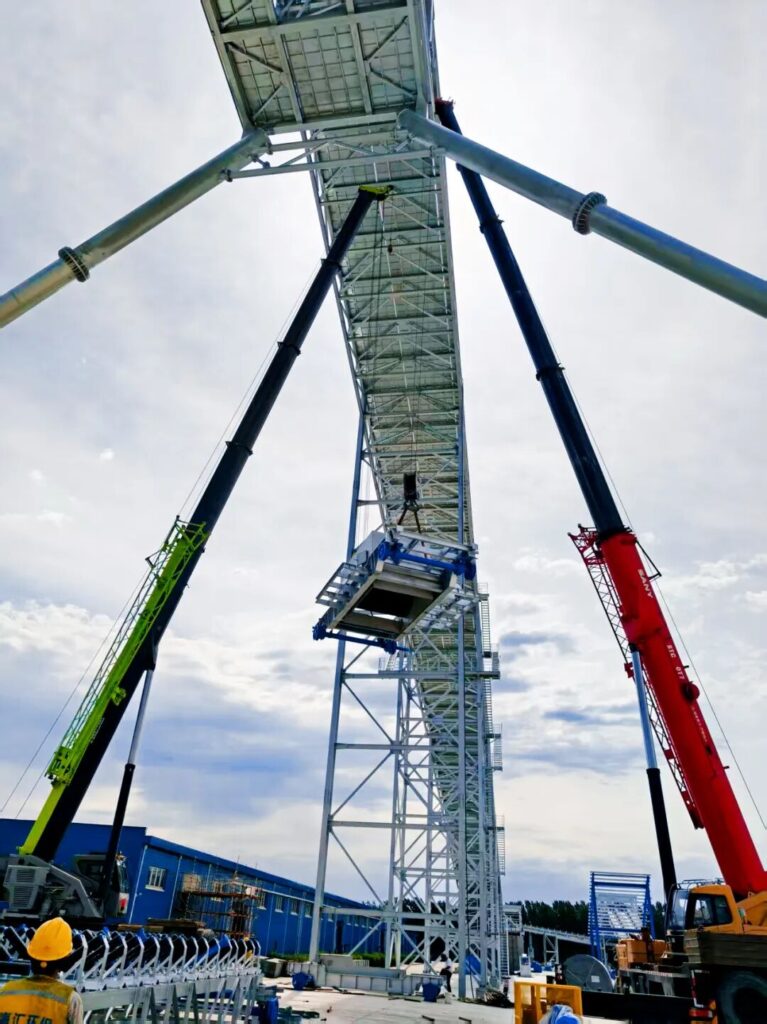
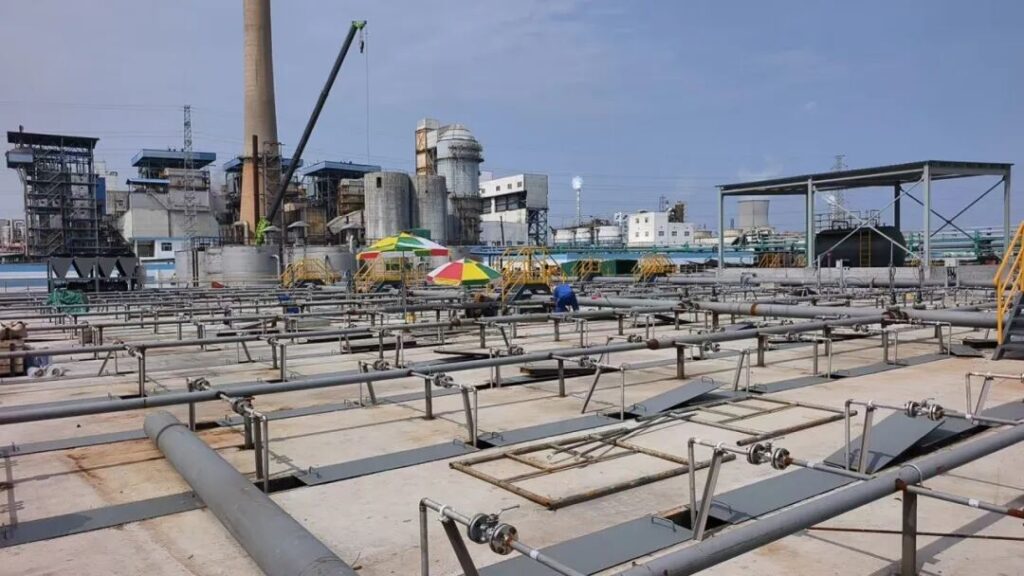
In Decheng, Dezhou, construction has reached a critical stage on a large-scale chemical park wastewater treatment facility. The plant occupies approximately 76 acres ($50,667 \text{ m}^2$) and serves as a vital environmental hub for regional industrial liquid waste management.
Equipment Installation Milestones
- Structural Framing: All primary civil concrete basins and process structures are poured and cured.
- Mechanical Drive Units: Over 90% of core mechanical process hardware—including sludge scrapers, mechanical agitators, and high-pressure pumps—is mounted.
- Biochemical Processing: Specialized treatment units in the Northern Biochemical Zone and Carbon-1 Wastewater Processing Unit are undergoing mechanical piping connection.
- Advanced Separation Filtration: Over 1,000 process units, including flash mixers for high-efficiency clarifiers and industrial ozone generators, are placed on structural foundations. Installation and loop testing for Ultrafiltration (UF), Reverse Osmosis (RO), and Membrane Concentration units are proceeding sequentially.
| Process Unit Area | Operational Focus | Machinery Deployed | Mechanical Completion (%) |
| Northern Biochemical Zone | Organic load reduction & nitrification | Mechanical mixers & aeration grids | $92\%$ |
| Carbon-1 Wastewater Unit | Refractory COD treatment | Industrial ozone generators & dosing pumps | $88\%$ |
| High-Efficiency Clarifiers | Suspended solids separation | High-torque sludge scrapers & flash agitators | $95\%$ |
| Membrane Separation Unit | Zero liquid discharge (ZLD) preparation | Ultrafiltration (UF) & Reverse Osmosis (RO) skids | $85\%$ |
3. Ultra-Low Emission Dust Control Retrofits in Steel Manufacturing
To meet stringent environmental regulatory limits, Haihui is implementing comprehensive baghouse dust collection retrofits at a major steel production facility in Linyi, Shandong. The project addresses three primary dust-generating zones: coal silos, ore bins, and blast furnace casthouses.
Zone-Specific Engineering Progress
- Coal Silo Zone: Structural fabrication and filter housing installation are 100% complete. Electrical wiring is finished, and the system is staged for cold commissioning.
- Ore Bin Zone: The main baghouse structural frame, hopper assemblies, and ductwork networks are fully installed. Field crews are aligning main centrifugal draft fans and assembling pneumatic ash handling systems.
- Blast Furnace Casthouse Zone: Civil foundations and structural prep work are finalized, with ductwork support steel currently under erection.
Once operational, the centralized baghouse dust collection network will capture fugitive particulate matter across all production stages, ensuring compliance with ultra-low industrial emission standards.
4. Intelligent Conveyor Systems for Paper Manufacturing Facilities
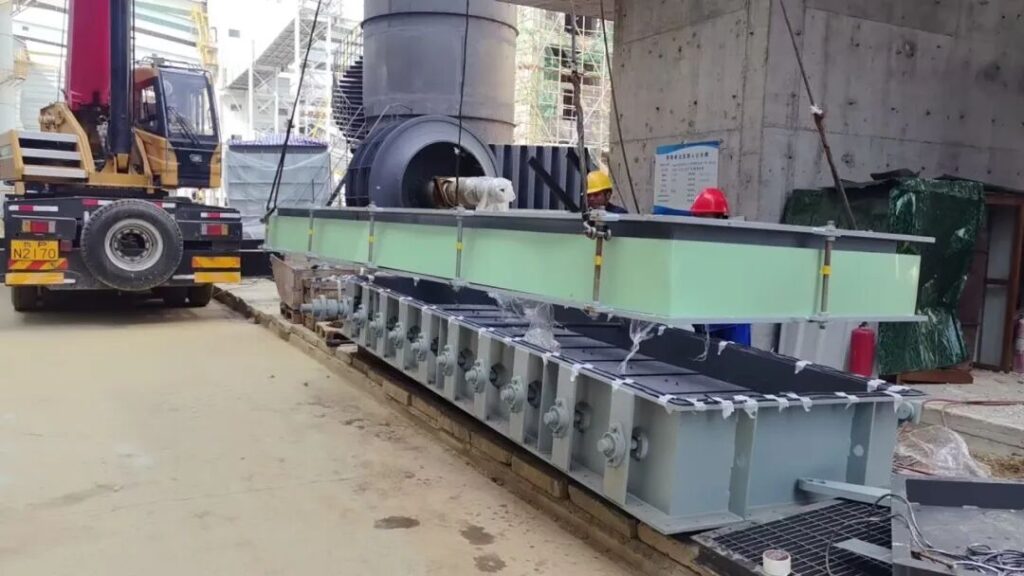
At production bases in Yandian and Zoucheng, Jining, crews are manufacturing and installing 45 intelligent belt conveyor lines.
Yandian Sun Paper Project Segment
- Installation Status: All conveyor lines meeting civil site delivery conditions are fully assembled and mechanically aligned.
- Overall Completion: Project execution has surpassed 85%.
- Next Steps: Final mechanical alignment, conveyor belt vulcanization splicing, and integrated system cold testing prior to material commissioning.
5. Integrated Flue Gas Desulfurization and Dust Removal Systems
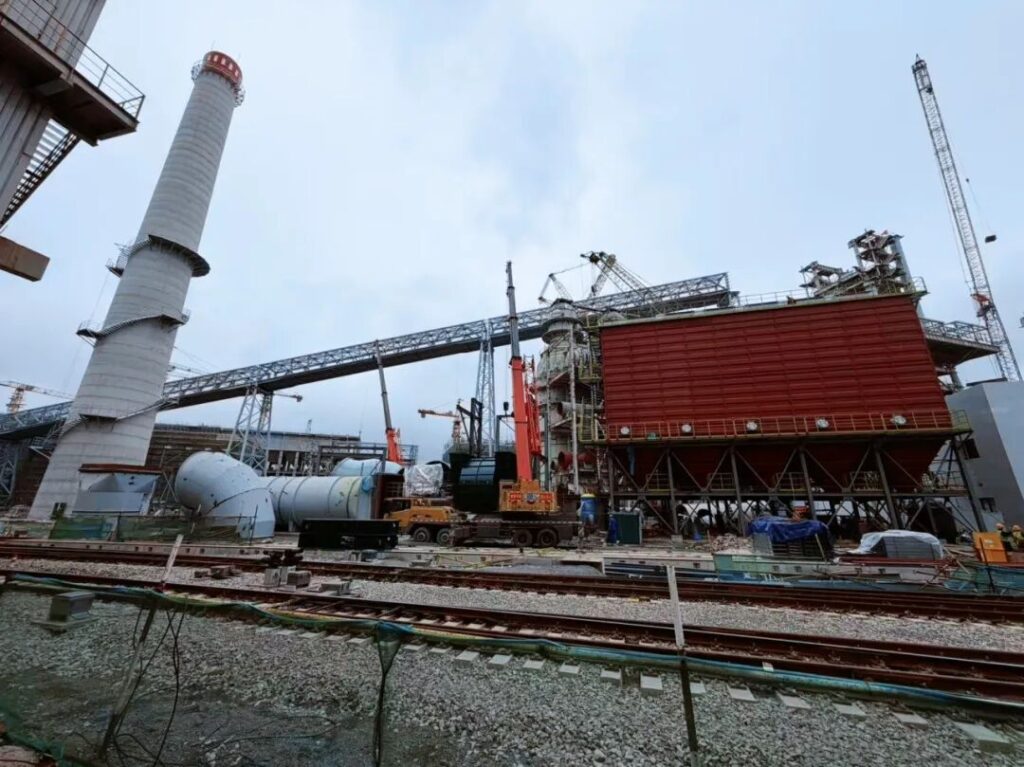
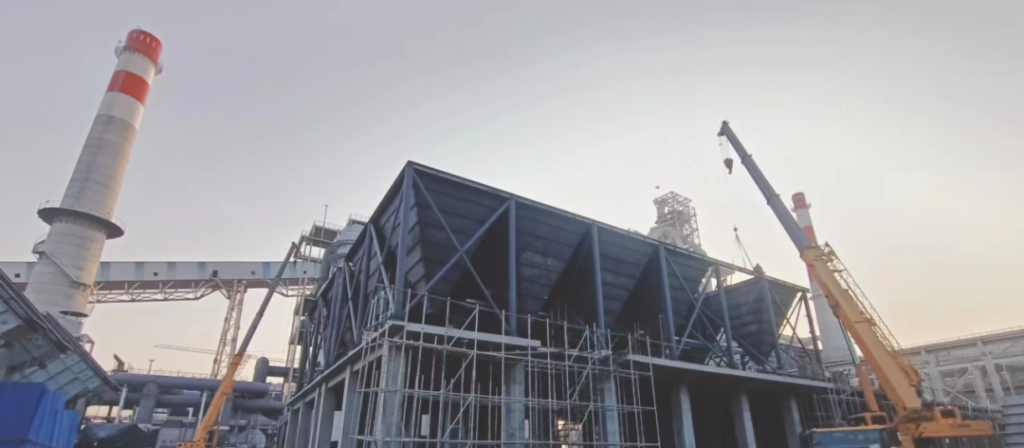
In Jiangsu Province, an integrated dry/semi-dry desulfurization and baghouse dust collection system has completed mechanical installation and entered the system testing and commissioning phase.
                      [ Flue Gas Path ]
                             │
                             ▼
              [ Integrated Dry/Semi-Dry Reactor ]
              - SO2 Reactant Injection
                             │
                             ▼
            [ High-Efficiency Baghouse Collector ]
            - Online Pulse-Jet Bag Cleaning
            - Particulate Removal (< 1 mg/Nm³)
                             │
                             ▼
              [ Clean Gas Stack Discharge ]
Key Modular Erection Strategy
To manage tight site schedules and minimize high-altitude assembly risks, major baghouse modules were pre-assembled on ground fixtures and set in place using heavy crane lifts. This approach protected structural integrity, improved weld quality, and provided safe access for filter bag installation and piping connections.
Emission Performance Specifications
The combined desulfurization and filtration process supports online bag replacement, allowing continuous plant operation during routine filter maintenance.
$$\text{Particulate Emission Concentration} \le 1.0 \text{ mg/Nm}^3$$
This engineered collection efficiency supports the facility in meeting regional ultra-low emission targets.
6. Local Industrial Dust Control and Global Equipment Delivery
At the Rizhao industrial project site, fabrication and erection of baghouse dust collection systems have reached 85% completion.
- Structural Welding: Field crews are executing multi-pass seal welding on clean-air plenums and main baghouse hopper enclosures.
- Ducting Systems: Ductwork manufacturing is in its final phase, with structural pipe racks and support framing currently being anchored.
- International Order Fulfillment: Manufacturing lines are executing export delivery contracts and providing engineering technical support for heavy industrial clients in Australia, Canada, and Germany.
- Domestic Regional Projects: Additional construction projects in Yantai, Tianjin, and Taiwan are proceeding according to scheduled engineering milestones.
7. Engineering Calculations for Conveyor Drive Power and Dust Collector Sizing
Conveyor Drive Power Calculation
To verify motor sizing for heavy-duty belt conveyors operating under full load, application engineers use the standard drive power calculation formula (based on DIN 22101 standards):
$$P_M = \frac{F_U \cdot v}{1000 \cdot \eta}$$
Where:
- $P_M$ = Required electric motor shaft power ($\text{kW}$)
- $F_U$ = Total peripheral drive force at the drive pulley ($\text{N}$)
- $v$ = Belt velocity ($\text{m/s}$)
- $\eta$ = Overall mechanical drive efficiency ($\approx 0.88 – 0.92$)
The peripheral drive force $F_U$ accounts for main resistance ($F_H$), secondary resistance ($F_N$), special resistance ($F_S$), and slope resistance ($F_{St}$):
$$F_U = F_H + F_N + F_S + F_{St}$$
Field Calculation Example: A coal handling belt conveyor operates at a velocity $v = 3.15 \text{ m/s}$ with a calculated total drive resistance force $F_U = 28,500 \text{ N}$. Assuming a drive powertrain efficiency $\eta = 0.90$:
$$P_M = \frac{28500 \cdot 3.15}{1000 \cdot 0.90} = 99.75 \text{ kW}$$
A standard $110 \text{ kW}$ industrial electric motor is selected to provide a suitable operational safety margin.
Baghouse Air-to-Cloth Ratio Calculation
Filter sizing for pulse-jet dust collectors depends on the total gas flow rate and the allowable Air-to-Cloth Ratio ($v_A$):
$$A_{filter} = \frac{Q}{60 \cdot v_A}$$
Where:
- $A_{filter}$ = Total required filter media surface area ($\text{m}^2$)
- $Q$ = Volumetric flue gas flow rate ($\text{m}^3/\text{h}$)
- $v_A$ = Filtering velocity or Air-to-Cloth ratio ($\text{m}^3/\text{m}^2/\text{min}$ or $\text{m/min}$)
For steel mill blast furnace casthouse dust control, a conservative filtering velocity $v_A = 0.9 \text{ m/min}$ is typically selected. For a flue gas volume $Q = 360,000 \text{ m}^3/\text{h}$:
$$A_{filter} = \frac{360000}{60 \cdot 0.9} = 6,667 \text{ m}^2$$
8. Frequently Asked Questions (FAQ)
Q1: How does modular crane lifting improve safety during baghouse installation?
Pre-assembling heavy structural modules on the ground reduces high-altitude welding and rigging hours. This minimizes worker exposure to fall hazards, improves structural weld inspection accessibility, and prevents distortion of main seal flanges.
Q2: What design features enable ultra-low particulate emissions below 1.0 mg/Nm³?
Achieving sub-$1.0 \text{ mg/Nm}^3$ emissions requires a combination of high-density PTFE-membrane filter media, precision-machined venturi nozzles, leak-tight cell plate seal rings, and automated differential pressure pulse-jet cleaning systems.
Q3: How are belt conveyor lines calibrated to prevent belt mistracking?
During installation, engineers check pulley structural squareness within $\pm 0.5 \text{ mm}$ and verify idler frame alignment along the conveyor centerline using optical transit instruments. Self-aligning training idlers and grooved drive pulley rubber linings are installed to maintain belt tracking under variable loads.
9. References and Industry Standards
- DIN 22101:2011-12: Continuous Conveyors – Belt Conveyors for Loose Bulk Materials – Basics for Calculation and Dimensioning.
- ISO 5048:1989: Continuous Mechanical Handling Equipment – Belt Conveyors with Carrying Idlers – Calculation of Operating Power and Tensile Forces.
- GB 50408-2007: Code for Construction and Acceptance of Industrial Dust Collection and Extraction Engineering.
- HJ 2028-2013: Technical Specifications for Industrial Flue Gas Desulfurization Engineering – Dry / Semi-dry Process.

 English
 العربية
 Português do Brasil
 Русский
 Español