
How to Specify Custom Driver Pulleys That Maximize Conveyor Uptime
- Harmonious Highlights for Custom Driver Pulleys
- Welded Steel Drum Pulley
- Wing Pulley for Sticky Materials
- Motorized Pulley for Compact Drives
- Shaft Diameter Sized for Fatigue, Not Just Torque
- Lagging Compound Matched to Site Conditions
- Bearing Protection for Dust, Water, and Heat
- Correct Shaft Sizing for Stall and Start Conditions
- Lagging That Grips Without Damaging the Belt
- Bearing Life in Harsh Environments
- Weld Quality and Stress Relief
- Field-Replaceable Lagging for Maintenance Flexibility
- Heavy-Duty Mining and Aggregate Drives
- Cement and Clinker Handling
- Port and Ship Loading Terminals
- Power Plants and Coal Handling
Custom driver pulleys aren’t just steel cylinders wrapped in rubber; they’re the difference between a conveyor that runs for years and one that slips, seizes, or tears belts when operators least expect it.
Get the lagging compound wrong, undersize the shaft, or ignore the bearing environment, and you’re paying for belt slip, premature lagging wear, and unplanned downtime—money leaking shift after shift.
Haihui engineers emphasize shaft fatigue analysis, lagging compound selection, and bearing protection as the baseline for dependable drive pulley performance. Drawing on our experience manufacturing welded steel drum pulleys for bulk material handling across cement, power, mining, port, and steel industries, we build driver pulleys that hold traction and survive the worst the site throws at them.
Harmonious Highlights for Custom Driver Pulleys
➔ Form Foundations: Choose drum, wing, or motorized configurations based on tension, space, and belt type—each delivers different grip and self-cleaning behavior.
➔ Lagging Logic: Select rubber, ceramic, or polyurethane compounds matched to wet, abrasive, or oily conditions to prevent slip without shredding the belt cover.
➔ Structural Strength: Verify shaft diameter against fatigue and deflection limits, not just steady-state torque, so the pulley survives stall conditions and repeated starts.
➔ Bearing Protection: Specify labyrinth seals, IP-rated housings, and lubrication plans that match the dust, moisture, and temperature profile of the site.
Which Driver Pulley Configurations Boost Conveyor Reliability?
Great conveying starts at the drive. In the world of custom driver pulleys, configuration quietly shapes traction, belt tracking, and maintenance frequency. From solid drum pulleys to integrated motorized units, smart pulley design turns raw motor torque into years of steady material flow.
Welded Steel Drum Pulley
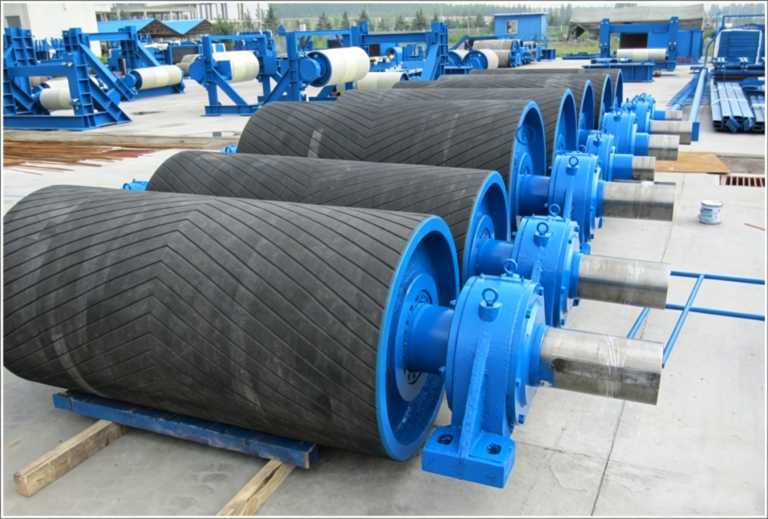
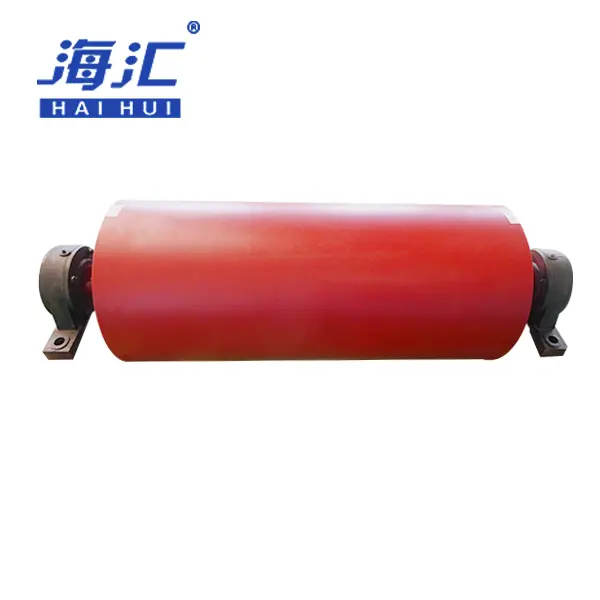
The welded steel drum pulley is the workhorse of heavy bulk handling. A rolled steel shell, machined end discs, and a forged or cold-drawn shaft are welded into a single rigid unit. For drive applications, the shell surface carries lagging to grip the belt.
Key performance layers:
- Shell stiffness under belt tension
- Weld integrity at end disc connections
- Shaft fatigue resistance at bearing seats
Production flow typically follows:
- Shell rolling and longitudinal seam welding
- End disc machining and fitting
- Circumferential welding and stress relief
- Lagging application and dynamic balancing
Performance comparison across pulley types:
| Configuration | Typical Tension Range (kN/m) | Lagging Flexibility | Self-Cleaning | Best For |
|---|---|---|---|---|
| Welded Drum (plain) | 50–300 | High | Low | Standard drives, dry materials |
| Welded Drum (lagged) | 100–600 | High | Medium | Wet or slippery conditions |
| Wing Pulley | 30–200 | Low | High | Sticky, fibrous materials |
| Моторизованный шкив | 20–150 | Medium | Low | Compact spaces, clean environments |
For operations handling abrasive ores or cement clinker, a lagged welded drum pulley from Haihui combines shell thickness options from 6 mm to 25 mm with lagging compounds matched to the material. Partnering with a manufacturer that controls welding, machining, and lagging in-house keeps tolerances tight and delivery predictable.
Wing Pulley for Sticky Materials
A wing pulley uses steel bars or fins welded to the shaft instead of a solid shell. Material falls through the gaps, so buildup sheds naturally. That makes it a practical choice when the belt carries wet, sticky, or fibrous loads.
Core advantages:
- Self-cleaning action reduces carryback
- Lower rotating mass than solid drum equivalents
- Simple field inspection without removing the belt
In practical conveyor design:
- The wing structure supports the belt but doesn’t trap material.
- Gaps allow fines and moisture to drop away.
- The open design suits return-side and drive positions on challenging belts.
Many aggregate and recycling operations choose wing pulleys for the drive position when carryback is a chronic problem. Haihui manufactures wing pulleys with wear-resistant bar stock and reinforced end plates to handle the impact of lumpy feed.
Motorized Pulley for Compact Drives
A motorized pulley integrates the motor, gearbox, and bearings inside the shell. No external drive components, no exposed couplings, no separate gearbox foundation. Power and control cables enter through the shaft.
Why operators choose it:
- Dramatically smaller footprint
- Sealed internals protected from dust and water
- Reduced installation and alignment work
Protection and performance envelope:
- Enclosure ratings commonly IP66 or IP67
- Power range typically 0.37 kW to 5.5 kW for medium-duty units
- Belt speeds from 0.13 m/s to 2.5 m/s depending on model
For conveyor layouts where space is tight or the environment is washdown-heavy, a motorized pulley simplifies the drive station. Haihui doesn’t manufacture motorized pulleys directly, but we supply the drum pulleys, lagging, and structural components that support conventional drive arrangements for customers who prefer external drives.
3 Key Features in Driver Pulley Engineering
A driver pulley that slips or cracks isn’t a pulley problem—it’s a design and manufacturing problem. When specifying a custom driver pulley, the engineering details determine whether the unit delivers traction for a decade or fails within months.
Shaft Diameter Sized for Fatigue, Not Just Torque
The shaft is the most failure-prone component in a heavily loaded driver pulley. It must resist bending from belt tension, torsion from motor torque, and the combined effect of both under dynamic conditions.
Core design checks:
- Bending stress at the bearing seat
- Torsional shear stress at the drive connection
- Combined equivalent stress at the critical section
- Deflection at the bearing seat to protect bearing life
Industry practice for shaft materials and allowable stresses:
| Material | Typical Application | Allowable Bending Stress (MPa) | Notes |
|---|---|---|---|
| EN3 / 070M20 | Light-duty, non-drive | 43 | Low cost, limited fatigue life |
| EN8 / 080M40 | Standard drive and non-drive | 55 | Common general-purpose choice |
| EN19 / 709M40 | Heavy-duty drives | 83 | High tension, frequent starts |
| 42CrMo / 4140 | Mining-grade drives | 90–100 | Highest fatigue resistance |
Load factors of 1.5 to 1.75 are typically applied to bending moments, and 1.25 to 1.40 to torsional moments, to account for dynamic effects and starting torque.
Formula for bending-based shaft diameter (Rankine):
d_bending = [16 / (π × σ_allow)] × √(M_eq² + T²)
Where M_eq is the equivalent bending moment and T is the torsional moment.
Formula for deflection-based shaft diameter:
θ = (R × L²) / (E × I)
Where θ is the slope at the bearing seat (typically limited to 0.0015–0.0017 radians), R is the resultant belt load, L is the distance from bearing center to hub center, E is Young’s modulus (206,000 MPa for steel), and I is the second moment of area.
The governing diameter is the largest of the torsion-based, bending-based, and deflection-based results, rounded up to the next standard shaft size.
Lagging Compound Matched to Site Conditions
Lagging is the friction layer between the pulley and belt. The wrong compound accelerates belt cover wear or fails to grip in wet conditions. The right one extends both pulley and belt life.
Lagging selection by condition:
| Condition | Recommended Compound | Pattern | Typical Hardness (Shore A) |
|---|---|---|---|
| Dry, clean, general bulk | SBR or natural rubber | Plain or diamond | 60–70 |
| Wet, muddy, outdoor | SBR or EPDM | Herringbone | 60–70 |
| High abrasion, sharp ore | Abrasion-resistant rubber | Plain or grooved | 65–75 |
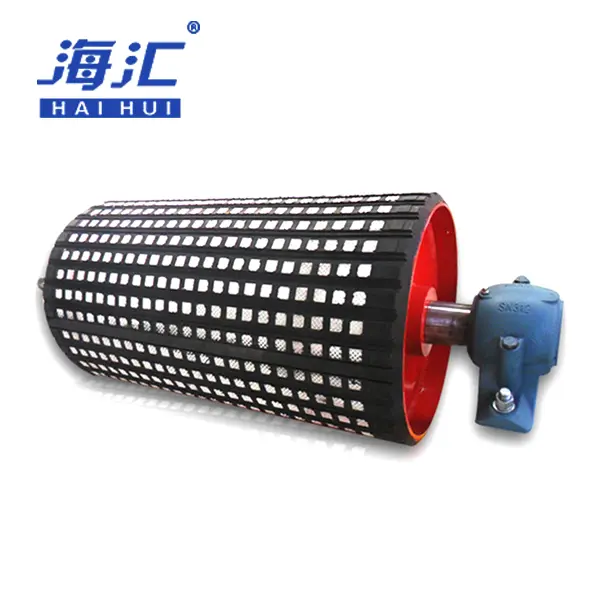
| High tension, slip-prone | Ceramic embedded | Checkered or full | 80+ |
| Oily, solvent-exposed | Nitrile (NBR) | Plain | 60–70 |
| Fire-risk underground | FRAS compound | Plain or grooved | 60–70 |
A 60-durometer lagging is the industry standard for general drive applications, balancing grip and wear life. Herringbone grooves channel water away and are directional—install them pointing in the direction of belt travel. Diamond grooves suit reversing conveyors. Ceramic lagging embeds hard tiles in a rubber matrix for maximum traction in wet, high-tension drives, but it can wear the belt cover if the application is mismatched.
Thickness guidance:
- Plain rubber lagging: 6–12 mm typical
- Ceramic lagging: 12–25 mm depending on tile size
- MSHA-approved lagging: minimum 12.7 mm (½ inch) for underground coal
Haihui applies lagging via hot vulcanization for drive pulleys, which provides stronger bond strength than cold bonding and resists debonding under high tension.
Bearing Protection for Dust, Water, and Heat
Bearing failure is the most common reason a driver pulley is pulled from service. The bearing environment determines how long it lasts.
Bearing selection considerations:
| Фактор | Recommended Practice |
|---|---|
| Bearing type | Spherical roller bearings for radial and axial load capacity |
| Расчистка | C3 or C4 for thermal expansion |
| Герметизация | Labyrinth seals for dust; contact seals for washdown |
| Housing | Cast or fabricated, with grease ports and drain paths |
| Lubrication | Lithium EP2 or polyurea; match temperature range |
For dusty environments like cement plants or coal handling, multi-stage labyrinth seals keep fine particles out of the bearing cavity. For washdown or outdoor installations, contact seals or combined labyrinth-contact seals resist water ingress. The goal is to keep the bearing running cool and clean for its rated L10 life, typically 30,000 to 60,000 hours depending on load and speed.
5 Operational Hooks for Driver Pulleys That Prevent Downtime
A driver pulley that fails takes the whole conveyor with it. The difference between a pulley that lasts and one that doesn’t often comes down to whether the specification matched the site’s real conditions—not the catalog conditions.
Correct Shaft Sizing for Stall and Start Conditions
Steady-state torque is rarely the limiting case. The shaft sees its highest stress during motor startup, sudden load surges, or a stalled belt. If the shaft was sized only for running torque, fatigue cracks can develop at the bearing seat or keyway.
Practical check:
- Confirm the motor’s starting torque multiplier (typically 1.5–2.5× full-load torque)
- Apply the appropriate load factor to the bending moment
- Verify deflection at the bearing seat stays within 0.0015 radians
Signs of undersized shaft:
- Vibration that increases over time
- Grease leaking from the bearing housing
- Visible shaft deflection under load
- Premature bearing failure on the drive side
Lagging That Grips Without Damaging the Belt
Lagging must provide enough friction to transmit torque without being so aggressive that it chews the belt cover. The balance depends on belt type, tension ratio, and environmental conditions.
Guidelines:
- For T1/T2 ratios below 1.5, plain rubber lagging is usually sufficient.
- For ratios between 1.5 and 1.75, diamond or herringbone grooved rubber improves grip.
- For ratios above 1.75, or in wet conditions with steel cord belts, ceramic lagging is often recommended.
- For reversing conveyors, use diamond pattern; herringbone is directional and unsuitable.
Belt cover protection: Ceramic lagging can cause bottom cover wear if the belt is not designed for it. In high-tension fabric belt applications, a softer rubber compound may extend belt life even if it requires a larger pulley diameter to achieve the same traction.
Bearing Life in Harsh Environments
Bearings fail when contaminants enter, lubrication degrades, or loads exceed capacity. In cement, mining, and port environments, all three risks are present.
Protection strategy:
- Sealing: Multi-stage labyrinth for dry dust; contact lip seals for wet or washdown conditions
- Housing: Machined fits, grease purge ports, and drain paths to prevent water pooling
- Lubrication: Lithium EP2 for general use; high-temperature or food-grade greases for special applications
- Monitoring: Vibration sensors or temperature probes on critical drive pulleys
Haihui manufactures pulley bearing housings with machined fits and provisions for standard sealing arrangements. For severe environments, we can supply stainless steel or coated housings.
Weld Quality and Stress Relief
The shell-to-end-disc weld is a high-stress joint. Poor penetration or lack of stress relief can lead to cracking under cyclic loading.
Quality checks:
- Weld procedure specification (WPS) for shell longitudinal and circumferential welds
- Non-destructive testing (NDT) on critical welds—ultrasonic or magnetic particle
- Post-weld stress relief for heavy-duty pulleys
- Dimensional inspection of shell roundness and end disc perpendicularity
A pulley with a cracked weld can fail suddenly, dropping the belt and potentially injuring personnel. Specifying NDT on critical welds is standard practice for drive pulleys in mining and heavy industry.
Field-Replaceable Lagging for Maintenance Flexibility
Even the best lagging wears out. Field-replaceable options reduce the time and cost of re-lagging.
Options:
- Slide lagging: Pre-formed lagging segments that slide onto the pulley face and lock in place; common for bucket elevator drive pulleys and tight-access installations.
- Cold-bond lagging: Pre-cured rubber strips bonded to the pulley face on-site; suitable for emergency repairs but lower bond strength than hot vulcanization.
- Weld-on strip lagging: Steel-backed rubber strips welded to the pulley face; robust but requires welding.
For critical conveyors, maintaining a spare lagged pulley or a field-replaceable lagging kit can cut downtime from days to hours.
Which Driver Pulley Specifications Suit Your Site?
Choosing the right driver pulley comes down to matching shaft strength, lagging compound, and bearing protection to the actual operating conditions—not the ideal conditions on a datasheet.
Heavy-Duty Mining and Aggregate Drives
Mining conveyors face the worst combination: high tension, abrasive material, frequent starts, and remote locations where downtime is expensive.
Specification priorities:
- Shaft material: 42CrMo or EN19 for fatigue resistance
- Lagging: ceramic or high-abrasion rubber, hot vulcanized
- Bearings: spherical roller, C3 clearance, labyrinth seals
- Shell: heavy-wall steel, NDT on welds
- Balancing: G-6.3 or better for high-speed drives
A drive pulley on a 1,200 mm belt carrying 180 kN tight-side tension and 60 kN slack-side tension generates a resultant load that demands a shaft diameter in the range of 100–120 mm, depending on bearing centers and face width. Undersizing the shaft to save cost risks fatigue failure within the first year.
Cement and Clinker Handling
Cement plants run conveyors through dust, heat, and abrasive clinker. Drive pulleys must resist both wear and contamination.
Specification priorities:
- Lagging: abrasion-resistant rubber, 10–15 mm thick
- Bearings: sealed for life or regreasable with purge ports
- Housing: protected from dust ingress
- Shell: wear-resistant liner or thickened wall at the drive zone
Cement conveyors often run at moderate tension but high dust loads. Bearing sealing is the critical factor for long life.
Port and Ship Loading Terminals
Port conveyors handle high tonnage with variable loading and outdoor exposure. Salt air and rain add corrosion to the challenge.
Specification priorities:
- Lagging: herringbone or diamond grooved rubber for wet grip
- Shaft: EN19 or equivalent, sized for fatigue
- Housing: hot-dip galvanized or stainless steel options
- Bearings: sealed against moisture, with water-resistant grease
Port terminals often operate 24/7, so reliability and field-replaceable lagging are important.
Power Plants and Coal Handling
Coal conveyors combine dust, fire risk, and continuous operation. Safety and reliability are the top priorities.
Specification priorities:
- Lagging: FRAS (Fire Retardant Anti Static) compound for underground or enclosed galleries
- Bearings: sealed, with temperature monitoring
- Shaft: sized for stall torque
- Welds: NDT and stress relief
For above-ground coal handling, standard abrasion-resistant rubber lagging is typically sufficient. For enclosed or underground installations, FRAS lagging is mandatory in many jurisdictions.
Custom Driver Pulley Manufacturing at Haihui
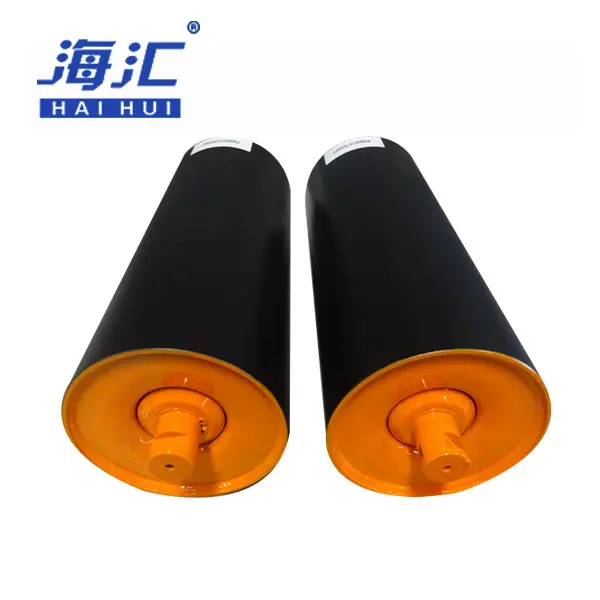
Haihui Environmental Protection Equipment Co., Ltd. is a manufacturer of belt conveyor pulleys, rollers, and structural components based in Rizhao, Shandong, China. The company operates 12 intelligent production workshops with an annual output capacity of 15,000 sets of equipment and holds 168 authorized patents, including 15 invention patents.
Product scope: welded steel drum pulleys, wing pulleys, bend pulleys, and complete pulley assemblies for belt conveyors. Belt widths from 400 mm to 2,400 mm; pulley diameters from 200 mm to 1,600 mm. Materials include Q235 carbon steel and custom alloy steels for high-tension applications.
Quality systems: ISO 9001, ISO 14001, ISO 45001, and ISO 50001 certified. Products are manufactured to CEMA, AS, DIN, ISO, and GB standards.
Export markets: Products are exported to the United States, Russia, Canada, Australia, Egypt, South America, the Middle East, and Southeast Asia. Haihui has established long-term partnerships with major steel and paper producers including Shandong Iron and Steel Group, Yongfeng Iron and Steel, Nine Dragons Paper, and Sun Paper.
Service capability: Professional sales team with 24-hour response, sample delivery in 1–2 days, OEM customization for products, logos, and packaging, and small-quantity order acceptance for urgent requirements.
FAQ about Driver Pulleys
Q: What is a driver pulley on a belt conveyor?
A: A driver pulley is the powered pulley that transmits torque from the motor and gearbox to the conveyor belt. It is typically located at the discharge end of the conveyor and is lagged to provide friction between the pulley surface and the belt.
Q: What is the difference between a driver pulley and a bend pulley?
A: A driver pulley transmits power to the belt and is connected to the drive unit. A bend pulley changes the belt direction or increases the wrap angle around the driver pulley. Bend pulleys are not connected to a motor and do not transmit drive torque.
Q: What is the purpose of pulley lagging?
A: Lagging increases friction between the pulley and belt, preventing slip. It also protects the pulley shell from wear and can improve belt tracking. Common lagging materials include rubber, ceramic, and polyurethane.
Q: How do I choose the right lagging for my driver pulley?
A: Choose based on operating conditions. Plain rubber lagging suits dry, clean environments. Herringbone or diamond grooved rubber works in wet conditions. Ceramic lagging provides maximum grip for high-tension drives. FRAS lagging is required for fire-risk applications.
Q: What shaft material should I specify for a heavy-duty driver pulley?
A: EN19 (709M40) and 42CrMo (4140) are common choices for heavy-duty drive pulleys. EN19 offers allowable bending stress around 83 MPa, while 42CrMo can reach 90–100 MPa with appropriate heat treatment.
Q: How is shaft diameter calculated for a driver pulley?
A: Shaft diameter is governed by the largest of three criteria: torsion-based diameter (using allowable shear stress), bending-based diameter (using equivalent bending moment), and deflection-based diameter (limiting slope at the bearing seat to 0.0015–0.0017 radians).
Q: What is the minimum pulley diameter for a given belt?
A: Minimum pulley diameter depends on belt carcass material and thickness. ISO 3684 provides factors (C) for different belt materials: nylon (C=90), polyester (C=108), and steel cord (C=145). Multiply the carcass thickness by the C factor to determine the minimum diameter.
Q: Can driver pulleys be repaired on site?
A: Lagging can be replaced on site using cold-bond or slide-lagging methods. Bearing replacement is possible with proper tools and access. Weld repairs on the shell or end discs should be performed in a workshop with NDT capabilities.
Q: What is the typical service life of a driver pulley?
A: With proper specification and maintenance, a welded steel driver pulley can last 10–15 years. Lagging typically requires replacement every 2–5 years depending on material abrasiveness and operating conditions. Bearing life depends on sealing, lubrication, and load.
Q: Does Haihui manufacture motorized pulleys?
A: Haihui manufactures conventional welded steel drum pulleys, wing pulleys, and bend pulleys. We do not currently manufacture motorized pulleys with integrated motors. For customers who prefer conventional external drives, we supply the drum pulley, lagging, and shaft assemblies.
Список литературы
- Haihui Environmental Protection Equipment Co., Ltd. – Belt Conveyor Ceramic Rubber Pulley product specification. haihuiconveyor.com
- Thomas Conveyor & Equipment – Pulley Lagging catalog: vulcanized lagging, MSHA-approved compounds, and lagging thickness requirements
- CEMA Standard B105.1-2021 – Specifications for Welded Steel Conveyor Pulleys with Compression Type Hubs, ANSI public review document
- Rulmeca – Motorized Pulleys 220M & 220H technical specifications and IP ratings
- Haihui Environmental Protection Equipment Co., Ltd. – Company profile and export markets. Made-in-China.com
- Continental Conveying Solutions – Pulley Strip Lagging Portfolio: lagging types, ceramic coverage, and bonding systems
- CEMA Standard B105.1-2015 – Pulley selection example: shaft diameter calculation and load ratings
- Superior Industries – Conveyor Pulley Lagging: Materials, Patterns, and Applications
- ISO 3684:1990 – Conveyor belts — Determination of minimum pulley diameters
- REMA TIP TOP – Pulley Lagging & Sleeves product overview
- Yile Machinery – Conveyor Pulley Selection Guide: shaft design, allowable stresses, and deflection limits
- Rizhao Daily – Haihui Environmental overseas orders grow, production capacity utilization exceeds 95%
 English
 العربية
 Português do Brasil
 Русский
 Español