
Heavy Duty Steel Conveyor Rollers: Selection, Materials, and Service Life
A heavy duty steel conveyor roller isn’t just a thick tube with bearings inside. It’s the component that decides whether your conveyor survives 20,000 tons per day or fails in the first month. It’s the difference between a maintenance schedule and a maintenance crisis.
Get the roller specification wrong, and the belt pays for it—edge damage, spillage, seized rolls, and unplanned downtime that eats into production targets. Get it right, and the heavy duty roller becomes the quiet workhorse that runs for tens of thousands of hours with minimal attention.
Haihui engineers emphasize tube wall thickness, shaft fatigue resistance, and seal integrity as the baseline for dependable heavy duty steel conveyor roller performance. Drawing on our experience manufacturing rollers for bulk material handling across cement, power, mining, port, and steel industries, we build rollers that keep belts running straight and smooth.
Harmonious Highlights for Heavy Duty Steel Conveyor Rollers
➔ Tube Wall Thickness: 3.0 mm to 8.0 mm depending on load—thin tubes deflect and kill bearings.
➔ Shaft Material Grade: 20#/40# carbon steel or 42CrMo alloy steel for fatigue resistance under high tension.
➔ Bearing & Seal Logic: Labyrinth seals with C3/C4 clearance bearings determine roller life in dust, moisture, and high-temperature conditions.
➔ Load Class Discipline: CEMA Class C through F rollers match load capacity to belt width and material weight.
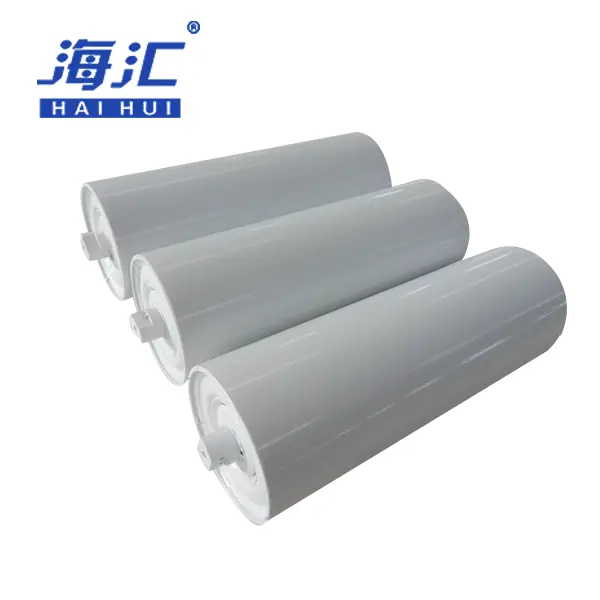
What Are Heavy Duty Steel Conveyor Rollers?
Heavy duty steel conveyor rollers are idler rollers designed for the most demanding bulk material handling applications. They differ from standard rollers in three key ways: thicker tube walls, larger shaft diameters, and more robust bearing and seal systems.
Where they are used:
- Primary crushed ore conveyors in mining
- Clinker and raw meal handling in cement plants
- Coal handling in power stations
- Ship loading and unloading at ports
- Sinter and pellet handling in steel plants
What sets them apart:
| Особенность | Standard Roller | Heavy Duty Steel Roller |
|---|---|---|
| Толщина стенки трубы | 2.0–3.0 mm | 4.0–8.0 mm |
| Shaft diameter | 20–25 mm | 30–50 mm |
| Bearing type | 6204–6205 | 6305–6308 |
| Seal type | Одиночный лабиринт | Multi-passage labyrinth |
| Load class | CEMA B/C | CEMA D/E/F |
| Typical belt width | 400–1000 mm | 1200–2400 mm |
For operations moving thousands of tons per hour, a standard roller simply won’t survive. The heavy duty steel conveyor roller is built for that environment.
Roll Diameter and Belt Width Matching
The roller diameter directly affects belt support and roller rotational speed. A roller that’s too small for the belt width causes excessive belt sag between rollers and accelerates bearing wear.
Recommended heavy duty roller diameter by belt width:
| Belt Width (mm) | Recommended Roller Diameter (mm) | Typical Shaft Diameter (mm) | Load Class |
|---|---|---|---|
| 1000–1200 | 133 | 30 | CEMA D |
| 1400–1600 | 159 | 40 | CEMA D/E |
| 1800–2000 | 194 | 50 | CEMA E |
| 2200–2400 | 219 | 60 | CEMA F |
Reference: CEMA Standard 502 and Haihui heavy duty roller product specifications
Normal carrying idler spacing is 1.0 to 1.5 meters depending on belt width and material weight. Return idler spacing is typically 3.0 meters. Impact idlers at loading points should be spaced at 0.3 to 0.5 meters to protect the belt.
Tube Materials and Wall Thickness for Heavy Duty Rollers
The tube is the backbone of the heavy duty steel conveyor roller. Its roundness, concentricity, and wall thickness consistency determine how well the roller performs under load.
Tube material options:
| Material | Typical Wall Thickness | Best For | Notes |
|---|---|---|---|
| Q235B carbon steel | 3.0–5.0 mm | General industrial | Cost-effective, weldable |
| Q345B high-strength steel | 5.0–8.0 mm | Heavy ore, high impact | Higher yield strength |
| Stainless steel 304/316 | 3.0–5.0 mm | Corrosive environments | Chemical, food, coastal |
| Seamless tube | 4.0–8.0 mm | High-speed, precision | Uniform wall, better balance |
Wall thickness selection guide:
| Заявка | Recommended Wall Thickness | Reason |
|---|---|---|
| Light aggregate, grain | 3.0–3.5 mm | Lower load, cost-sensitive |
| Coal, cement | 3.5–4.5 mm | Moderate abrasion, continuous duty |
| Iron ore, hard rock | 4.5–6.0 mm | High impact, abrasive |
| Large lump, high drop | 6.0–8.0 mm | Extreme impact, heavy load |
A tube that’s not round will kill bearings fast. Concentricity is not optional. Haihui holds tube roundness to within 0.2 mm and wall thickness tolerance to ±0.3 mm.
Shaft Materials and Fatigue Resistance
The shaft carries the belt load and transmits it to the frame. In heavy duty applications, the shaft must resist bending from belt tension, torsion from any drive connection, and the combined effect under dynamic conditions.
Shaft material options:
| Material | Allowable Bending Stress (MPa) | Typical Application | Fatigue Life Factor |
|---|---|---|---|
| 20# steel | 43 | Light-duty, non-drive | 1.0 (baseline) |
| 40# steel | 55 | Standard heavy duty | 1.3 |
| 42CrMo alloy | 90–100 | Mining-grade, high tension | 2.3 |
| Stainless 304/316 | 50–60 | Corrosive environments | 1.5 |
Shaft diameter calculation (simplified):
d = [16 / (π × σ_allow)] × √(M_eq² + T²)
Where M_eq is the equivalent bending moment and T is the torsional moment.
For heavy duty steel conveyor rollers, shaft diameter is typically sized with a load factor of 1.5 to 1.75 applied to the bending moment, and 1.25 to 1.40 to the torsional moment, to account for dynamic effects and starting torque.
Signs of undersized shaft:
- Vibration that increases over time
- Grease leaking from the bearing housing
- Visible shaft deflection under load
- Premature bearing failure on the drive side
Bearing and Seal Design: The Life-Determining Factor
Bearing failure is the most common reason a heavy duty steel conveyor roller is pulled from service. The seal design determines how long the bearing lasts.
| Особенность | Basic Contact Seal | Multi-Passage Labyrinth Seal | Factory-Sealed Design |
|---|---|---|---|
| Contamination resistance | Moderate | High | High |
| Regreasable | No | Yes | No |
| Типичная область применения | Чистые и сухие помещения | Dusty, wet, outdoor | Remote or hard-to-access locations |
| Bearing life tendency | Standard | Extended | Extended |
| Maintenance requirement | Replace on failure | Periodic regreasing | Install and forget |
Regreasable idlers use a labyrinth and outer shield design, allowing periodic regreasing to flush contaminants. Factory-sealed idlers use the same seal design with a solid shaft and are a viable economic alternative where periodic regreasing will not be provided.
For mining and cement applications with high dust loads, a multi-passage labyrinth seal is the minimum specification. For washdown or corrosive environments, consider contact seals or combined labyrinth-contact seals.
Troubleshooting Common Heavy Duty Roller Problems
Even well-specified heavy duty rollers can develop problems. Here’s how to diagnose and fix the most common issues.
Roller Seizure
Symptoms: Roller does not rotate; flat spot worn on the tube; belt drag increases.
Causes:
- Bearing failure from contamination or lack of lubrication
- Seal failure allowing dust ingress
- Overload beyond the roller’s rated capacity
Fixes:
- Replace the seized roller immediately to prevent belt damage
- Check seal type and upgrade if contamination is the root cause
- Verify load class matches actual load
Belt Mistracking at Roller Sets
Symptoms: Belt runs to one side; edge wear; material spillage.
Causes:
- Idler frame not perpendicular to belt centerline
- Uneven roll heights in the troughing set
- Material buildup on rollers
Fixes:
- Realign the idler frame
- Replace worn or damaged rollers in the set
- Install training idlers or spiral idlers for sticky materials
Excessive Roller Noise
Symptoms: Squealing, grinding, or rattling from the roller.
Causes:
- Dry bearing
- Contaminated bearing
- Loose shaft or mounting
Fixes:
- Regrease if the roller is regreasable
- Replace if the bearing is damaged
- Check mounting hardware and tighten
Roller Tube Wear
Symptoms: Flat spots, grooving, or uneven wear on the tube surface.
Causes:
- Abrasive material
- Belt slip
- Misalignment causing concentrated load
Fixes:
- Replace worn rollers
- Upgrade to abrasion-resistant tube surface
- Correct belt alignment
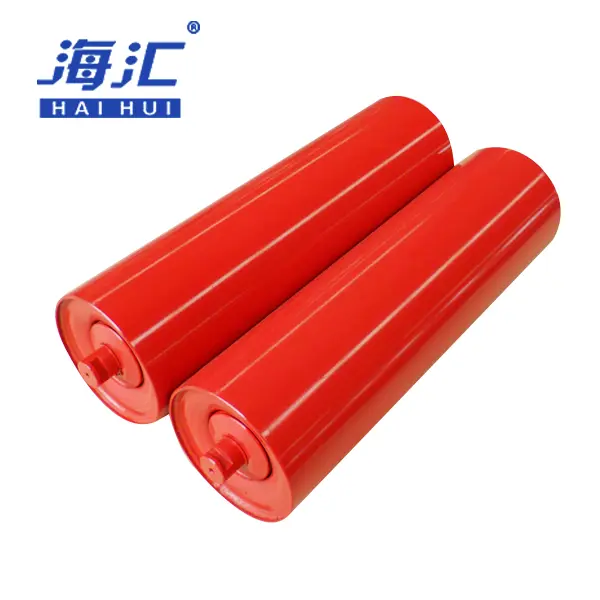
Heavy Duty Steel Conveyor Roller Specifications at Haihui
Haihui Environmental Protection Equipment Co., Ltd. is a manufacturer of belt conveyor idlers, pulleys, and structural components based in Rizhao, Shandong, China. The company operates 12 intelligent production workshops with an annual output capacity of 15,000 sets of equipment and holds 168 authorized patents, including 15 invention patents.
Product scope: heavy duty steel carrying rollers, return rollers, impact rollers, spiral rollers, rubber disc rollers, and complete roller assemblies for belt conveyors. Belt widths from 400 mm to 2,400 mm; roller diameters from 54 mm to 219 mm. Materials include Q235B carbon steel, Q345B high-strength steel, and stainless steel for corrosive applications.
Quality systems: ISO 9001, ISO 14001, ISO 45001, and ISO 50001 certified. Products are manufactured to CEMA, AS, DIN, ISO, and GB standards.
Export markets: Products are exported to the United States, Russia, Canada, Australia, Egypt, South America, the Middle East, and Southeast Asia.
Service capability: Professional sales team with 24-hour response, sample delivery in 1–2 days, OEM customization for products, logos, and packaging, and small-quantity order acceptance for urgent requirements.
FAQ about Heavy Duty Steel Conveyor Rollers
Q: What is a heavy duty steel conveyor roller?
A: A heavy duty steel conveyor roller is an idler roller designed for demanding bulk material handling applications. It features thicker tube walls, larger shaft diameters, and more robust bearing and seal systems than standard rollers.
Q: What is the difference between a standard roller and a heavy duty roller?
A: Heavy duty rollers have thicker tube walls (4.0–8.0 mm vs. 2.0–3.0 mm), larger shaft diameters (30–50 mm vs. 20–25 mm), larger bearings, and better seals. They are rated for higher load classes and wider belts.
Q: What tube wall thickness should I specify for heavy duty rollers?
A: Wall thickness depends on the application. Light aggregate uses 3.0–3.5 mm. Coal and cement use 3.5–4.5 mm. Iron ore and hard rock use 4.5–6.0 mm. Large lump and high drop applications use 6.0–8.0 mm.
Q: What shaft material is best for heavy duty rollers?
A: 20# steel suits light-duty applications. 40# steel suits standard heavy duty. 42CrMo alloy steel offers the highest fatigue resistance for mining-grade, high-tension applications.
Q: How do I choose the right CEMA idler class?
A: CEMA idler classes run from B (light-duty) through F (super heavy-duty). Selection depends on calculated idler load, belt width, material weight, and operating conditions. Undersizing the idler class leads to premature bearing failure.
Q: What is the normal spacing for heavy duty return rollers?
A: Normal spacing for return rollers is 10 feet (approximately 3 meters). Impact rollers should be at least 6-inch diameter and spaced at 1-foot intervals to maximize belt protection.
Q: What is the difference between regreasable and factory-sealed heavy duty rollers?
A: Regreasable rollers use a labyrinth and outer shield design, allowing periodic regreasing to flush contaminants. Factory-sealed rollers use the same seal design with a solid shaft and are a viable economic alternative where periodic regreasing will not be provided.
Q: When should I use spiral rollers instead of plain steel rollers?
A: Spiral rollers are self-cleaning and suit sticky, wet, or corrosive materials. They are one-directional only and should not be used on reversing conveyors.
Q: What is the typical service life of a heavy duty steel conveyor roller?
A: With proper specification and maintenance, a heavy duty steel conveyor roller can last 30,000 to 60,000 hours. Sealed labyrinth bearings extend life in dusty or wet conditions.
Q: Does Haihui manufacture heavy duty steel conveyor rollers for all conveyor applications?
A: Haihui manufactures heavy duty steel conveyor rollers for heavy-duty industrial conveyors in mining, cement, steel, power, port, chemical, and paper industries. We do not supply portable or light-duty conveyors used in warehouses or retail settings.
Список литературы
- CEMA Standard 502-2004 – Bulk Material Belt Conveyor Troughing and Return Idlers: Selection and Dimensions. Conveyor Equipment Manufacturers Association.
- MT/T 821-2006 – Belt conveyor for coal mines — Idlers — Technical specification. National Mine Safety Administration.
- Regal Rexnord – Rex Belt Conveyor Idlers and Components: seal features, idler types, and load ratings.
- Haihui Environmental Protection Equipment Co., Ltd. – Steel Carry Trough Idler Roller product specifications: belt width 400-2400 mm, roller diameter 54-219 mm, Q235B carbon steel.
- Haihui Environmental Protection Equipment Co., Ltd. – High Precision Industrial Conveyor Roller with Sealed Bearing: ISO 9001 certified.
- Haihui Group – Company profile: ISO9001, ISO14001, ISO45001, ISO50001 certified.
- Rizhao Daily – Haihui Environmental overseas orders grow, production capacity utilization exceeds 95%.
 English
 العربية
 Português do Brasil
 Русский
 Español