
Como escolher a polia de cauda correta para o seu sistema de correia transportadora
- Harmonious Highlights for Conveyor Tail Pulleys
- Solid Steel Drum Tail Pulley
- Wing Tail Pulley for Sticky Materials
- Self-Aligning Tail Pulley for Mistracking Conveyors
- Diameter Sized for Belt Fatigue, Not Just Space
- Lagging Compound Matched to Site Conditions
- Bearing Arrangement and Take-Up Integration
- Correct Diameter Selection for Belt Life
- Lagging That Protects Without Damaging the Belt
- Bearing Life in Harsh Environments
- Weld Quality and Stress Relief
- Field-Replaceable Lagging for Maintenance Flexibility
- Heavy-Duty Mining and Aggregate Drives
- Cement and Clinker Handling
- Port and Ship Loading Terminals
- Power Plants and Coal Handling
A conveyor tail pulley isn’t just a wheel at the back of the conveyor. It’s the component that keeps the belt tracking straight at the loading end, maintains tension on short systems, and protects the belt from unnecessary fatigue. When it’s undersized, misaligned, or built with the wrong lagging, the belt starts wandering, edges fray, material spills, and maintenance crews spend their shifts fixing problems instead of preventing them.
Old-school thinking treats the conveyor tail pulley as a passive part—something to buy cheap and replace often. But modern bulk handling demands better. Abrasive ores, wet cement, sticky fertilizers, and high-tonnage port operations all place demands on the tail pulley that a low-spec unit simply can’t survive.
Haihui engineers emphasize belt-friendly diameter selection, lagging matched to site conditions, and take-up integration as the baseline for dependable conveyor tail pulley performance. Drawing on our experience manufacturing welded steel drum pulleys for bulk material handling across cement, power, mining, port, and steel industries, we build tail pulleys that keep belts running straight and smooth.
Harmonious Highlights for Conveyor Tail Pulleys
➔ Lógica do diâmetro: Size the conveyor tail pulley to the belt carcass and splice type—too small accelerates belt fatigue; too large wastes space and cost.
➔ Seleção de atraso: Escolha compostos de borracha, cerâmica ou FRAS, dependendo das condições de umidade, abrasão ou risco de incêndio, para evitar escorregões e proteger o invólucro.
➔ Integração do rolamento e do tensionador: Adapte o tipo de rolamento, a vedação e o mecanismo de compensação aos requisitos de tensão e às condições ambientais da esteira transportadora.
➔ Suporte ao rastreamento: Specify crowned or flat face geometry, and consider self-aligning features where belt wander is a recurring problem.
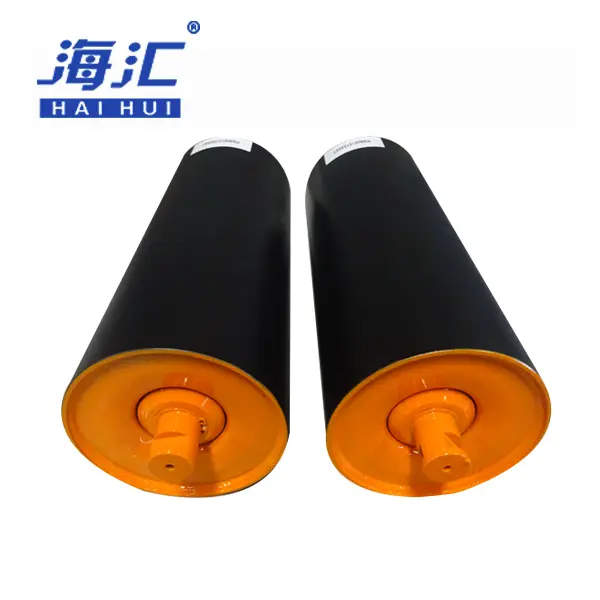
Which Conveyor Tail Pulley Configurations Boost Conveyor Reliability?
Great conveying starts at the loading end. In the world of custom conveyor tail pulleys, configuration quietly shapes belt training, tension control, and maintenance frequency. From solid drum pulleys to self-aligning designs, smart tail pulley selection turns raw belt tension into years of steady material flow.
Solid Steel Drum Tail Pulley
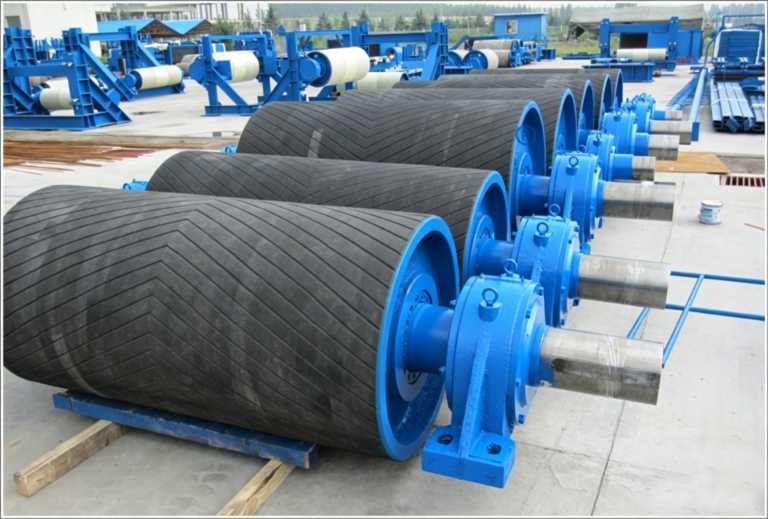
The solid steel drum tail pulley is the standard workhorse of bulk handling. A rolled steel shell, machined end discs, and a cold-drawn or forged shaft are welded into a rigid unit. The smooth shell surface gives the belt a stable path at the loading end.
Key performance layers:
- Shell stiffness under belt tension
- Weld integrity at end disc connections
- Shaft deflection control at bearing seats
Production flow typically follows:
- Shell rolling and longitudinal seam welding
- End disc machining and fitting
- Circumferential welding and stress relief
- Lagging application and dynamic balancing
Performance comparison across tail pulley types:
| Configuration | Typical Belt Width (mm) | Lagging Flexibility | Self-Cleaning | Ideal para |
|---|---|---|---|---|
| Solid Drum (plain) | 400–2400 | Alto | Low | Standard loading points, dry materials |
| Solid Drum (lagged) | 400–2400 | Alto | Medium | Wet or slippery conditions |
| Wing Pulley | 400–1800 | Low | Alto | Sticky, fibrous materials |
| Spiral-Wrapped | 600–2000 | Medium | Alto | Higher-speed self-cleaning applications |
| Self-Aligning | 800–2400 | Medium | Low | Conveyors prone to belt mistracking |
For operations handling abrasive ores or cement clinker, a lagged solid drum conveyor tail pulley from Haihui combines shell thickness options from 6 mm to 25 mm with lagging compounds matched to the material. Partnering with a manufacturer that controls welding, machining, and lagging in-house keeps tolerances tight and delivery predictable.
Wing Tail Pulley for Sticky Materials
A wing tail pulley uses steel bars or fins welded to the shaft instead of a solid shell. Material falls through the gaps, so buildup sheds naturally. That makes it a practical choice when the belt carries wet, sticky, or fibrous loads.
Principais vantagens:
- Self-cleaning action reduces carryback
- Lower rotating mass than solid drum equivalents
- Simple field inspection without removing the belt
In practical conveyor design:
- The wing structure supports the belt but doesn’t trap material.
- Gaps allow fines and moisture to drop away.
- The open design suits loading and return positions on challenging belts.
Many aggregate and recycling operations choose wing tail pulleys when carryback is a chronic problem. However, wing pulleys introduce oscillating action to the belt path and can destabilize belt sealing systems. CEMA advises against wing pulleys on belts traveling over 225 m/min (450 ft/min). Larger lumps can lodge in the wings, potentially causing the damage the design is meant to prevent.
A superior alternative is the spiral-wrapped tail pulley, which adds a steel strip spirally wrapped around the circumference to cover the wings. This maintains the self-cleaning function while eliminating belt bounce.
Self-Aligning Tail Pulley for Mistracking Conveyors
A self-aligning conveyor tail pulley pivots about a vertical axis to maintain belt tracking. When the belt drifts, a sensor detects the deviation and an actuator pivots the pulley support to increase tension on the side where the belt has drifted, steering it back to center.
Why operators choose it:
- Automatic correction of belt mistracking
- Reduced edge damage and spillage
- Lower maintenance intervention
Practical notes:
- Requires a control system and actuator
- Best suited for conveyors with recurring mistracking problems
- More complex than a fixed tail pulley, but reduces long-term belt damage
For conveyors handling variable loads or operating in challenging alignment conditions, a self-aligning tail pulley can pay for itself by extending belt life.
3 Key Features in Conveyor Tail Pulley Engineering
A conveyor tail pulley that causes belt damage isn’t a pulley problem—it’s a design and manufacturing problem. When specifying a custom tail pulley, the engineering details determine whether the unit delivers years of smooth belt travel or months of frustration.
Diameter Sized for Belt Fatigue, Not Just Space
The conveyor tail pulley diameter directly affects belt bending stress and splice fatigue. A pulley that’s too small for the belt carcass causes delamination of belt layers and laceration of the reinforcing fabric.
Recomendações quanto ao diâmetro mínimo da polia de saída com base no tipo de correia:
| Tipo de correia | Tensão da correia (%) | Diâmetro mínimo da polia traseira (mm) | Polia cônica/curvada (mm) |
|---|---|---|---|
| Correia têxtil (para serviços leves) | < 30% | 125 | 100 |
| Correia têxtil (padrão) | < 50% | 200 | 160 |
| Correia têxtil (para serviços pesados) | > 60% | 250 | 200 |
| EP multicamadas | > 60% | 400 | 315 |
| Cordão de aço | > 60% | 500 | 400 |
For high-tension applications, a larger conveyor tail pulley diameter increases belt service life. The weaker the surface pressure on the pulley, the better the belt/pulley adhesion coefficient becomes. Never undersize a tail pulley to save space—the belt will pay for it.
Lagging Compound Matched to Site Conditions
A aplicação de revestimento antideslizante na polia de saída tem duas finalidades: proteger o corpo da polia contra o desgaste e melhorar o alinhamento da correia. Ao contrário das polias motrizes, as polias de saída não precisam de atrito máximo para a transmissão de torque, mas precisam de aderência suficiente para manter a correia centralizada.
Seleção de atrasos por condição:
| Condição | Isolamento recomendado | Padrão | Notas |
|---|---|---|---|
| Carga a granel seca, limpa e de caráter geral | Borracha | Liso ou em losango | Opção padrão |
| Molhado, enlameado, ao ar livre | Borracha | Padrão em espinha de peixe | Direcional; canaliza a água |
| Minério altamente abrasivo e com bordas afiadas | Borracha resistente à abrasão | Liso ou ranhurado | Protege a carapaça |
| Transportador reversível | Borracha | Diamante | Não direcional |
| Risco de incêndio no subsolo | Composto FRAS | Liso ou ranhurado | Requisito de segurança |
| Correia estreita de baixa potência | Aço liso | Nenhum | Custo-benefício para serviços leves |
Smooth steel tail pulleys suit conveyors with low power requirements and narrow belt widths. Herringbone rubber lagging offers excellent friction factor, anti-slip, and drainage ability. Diamond rubber lagging works for two-way operating conveyors.
Bearing Arrangement and Take-Up Integration
A polia de cauda costuma servir como ponto de tensionamento em transportadores mais curtos. O mecanismo de tensionamento determina como a tensão da correia é mantida e como a polia é ajustada.
Comparação entre tipos de fixação:
| Tipo de fixação | Método de ajuste | Ideal para | Notas |
|---|---|---|---|
| Corrigido | Sem ajuste; a tensão da correia é definida de fábrica | Transportadores curtos com carga estável | Mais simples; sem ajuste no campo |
| Tensão por parafuso | Ajuste manual por meio de hastes roscadas | Transportadores de curta a média distância | Requer inspeção periódica |
| Enrolador por gravidade | Tensão automática por meio de contrapeso | Transportadores longos, cargas variáveis | Autoajustável; requer espaço |
Bearing arrangement options:
| Disposição dos rolamentos | Vantagens | Desvantagens | Ideal para |
|---|---|---|---|
| Rolamentos externos | Fácil acesso para lubrificação e substituição | Exposto à poeira e à umidade | Transportadores industriais padrão |
| Rolamentos internos | Protegido contra as intempéries; compacto | Mais difícil de inspecionar; requer a remoção da polia para manutenção | Ambientes sujeitos a lavagem, corrosivos ou com espaço limitado |
Em ambientes empoeirados, como fábricas de cimento ou instalações de manuseio de carvão, é comum o uso de rolamentos externos com vedações tipo labirinto. Para aplicações que envolvem lavagem ou em ambientes corrosivos, pode ser preferível o uso de rolamentos internos com vedações de contato.
5 Operational Hooks for Conveyor Tail Pulleys That Prevent Downtime
A conveyor tail pulley that fails takes the whole conveyor with it. The difference between a pulley that lasts and one that doesn’t often comes down to whether the specification matched the site’s real conditions—not the catalog conditions.
Correct Diameter Selection for Belt Life
Steady-state tension is rarely the limiting case. The belt sees its highest bending stress as it wraps around the tail pulley. If the pulley is undersized, the belt’s carcass fatigues faster than it should.
Practical check:
- Confirm belt carcass material (textile, EP, steel cord)
- Apply the minimum diameter recommendation for that belt type
- Verify splice type compatibility with the selected diameter
- Check that the pulley face width matches the belt width
Signs of undersized tail pulley:
- Belt cracking or delamination near the splice
- Visible belt edge damage at the loading end
- Shortened belt service life compared to expectations
Lagging That Protects Without Damaging the Belt
Lagging must provide enough grip to keep the belt centered without being so aggressive that it chews the belt cover. The balance depends on belt type, tension ratio, and environmental conditions.
Guidelines:
- For clean, dry applications, plain rubber lagging is usually sufficient.
- For wet or muddy conditions, herringbone grooved rubber improves water drainage.
- For reversing conveyors, use diamond pattern; herringbone is directional and unsuitable.
- For fire-risk underground applications, FRAS lagging is mandatory.
Belt cover protection: Ceramic lagging is generally not required on tail pulleys because they don’t transmit drive torque. A softer rubber compound is usually sufficient and gentler on the belt.
Bearing Life in Harsh Environments
Bearings fail when contaminants enter, lubrication degrades, or loads exceed capacity. In cement, mining, and port environments, all three risks are present.
Protection strategy:
- Sealing: Multi-stage labyrinth for dry dust; contact lip seals for wet or washdown conditions
- Housing: Machined fits, grease purge ports, and drain paths to prevent water pooling
- Lubrication: Lithium EP2 for general use; high-temperature or food-grade greases for special applications
- Monitoring: Vibration sensors or temperature probes on critical tail pulleys
Haihui manufactures pulley bearing housings with machined fits and provisions for standard sealing arrangements. For severe environments, we can supply stainless steel or coated housings.
Weld Quality and Stress Relief
The shell-to-end-disc weld is a high-stress joint. Poor penetration or lack of stress relief can lead to cracking under cyclic loading.
Quality checks:
- Weld procedure specification (WPS) for shell longitudinal and circumferential welds
- Non-destructive testing (NDT) on critical welds—ultrasonic or magnetic particle
- Post-weld stress relief for heavy-duty pulleys
- Dimensional inspection of shell roundness and end disc perpendicularity
A pulley with a cracked weld can fail suddenly, dropping the belt and potentially injuring personnel. Specifying NDT on critical welds is standard practice for tail pulleys in mining and heavy industry.
Field-Replaceable Lagging for Maintenance Flexibility
Even the best lagging wears out. Field-replaceable options reduce the time and cost of re-lagging.
Options:
- Slide lagging: Pre-formed lagging segments that slide onto the pulley face and lock in place; common for tight-access installations.
- Cold-bond lagging: Pre-cured rubber strips bonded to the pulley face on-site; suitable for emergency repairs but lower bond strength than hot vulcanization.
- Weld-on strip lagging: Steel-backed rubber strips welded to the pulley face; robust but requires welding.
For critical conveyors, maintaining a spare lagged pulley or a field-replaceable lagging kit can cut downtime from days to hours.
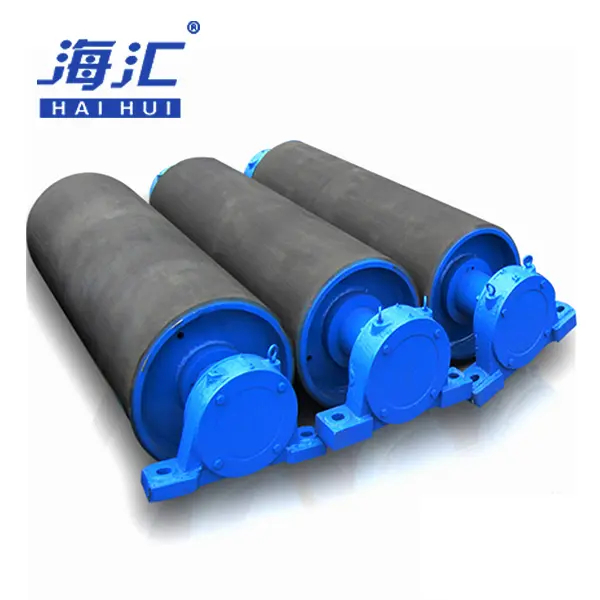
Which Conveyor Tail Pulley Specifications Suit Your Site?
Choosing the right conveyor tail pulley comes down to matching diameter, lagging compound, and bearing protection to the actual operating conditions—not the ideal conditions on a datasheet.
Heavy-Duty Mining and Aggregate Drives
Mining conveyors face the worst combination: high tension, abrasive material, frequent starts, and remote locations where downtime is expensive.
Specification priorities:
- Shaft material: 42CrMo or EN19 for fatigue resistance
- Lagging: high-abrasion rubber, hot vulcanized
- Bearings: spherical roller, C3 clearance, labyrinth seals
- Shell: heavy-wall steel, NDT on welds
- Diameter: sized for steel cord belt if applicable
A tail pulley on a 1,200 mm belt carrying steel cord carcass demands a minimum diameter of 500 mm to avoid belt fatigue.
Cement and Clinker Handling
Cement plants run conveyors through dust, heat, and abrasive clinker. Tail pulleys must resist both wear and contamination.
Specification priorities:
- Lagging: abrasion-resistant rubber, 10–15 mm thick
- Bearings: sealed for life or regreasable with purge ports
- Housing: protected from dust ingress
- Shell: wear-resistant liner or thickened wall at the loading zone
Cement conveyors often run at moderate tension but high dust loads. Bearing sealing is the critical factor for long life.
Port and Ship Loading Terminals
Port conveyors handle high tonnage with variable loading and outdoor exposure. Salt air and rain add corrosion to the challenge.
Specification priorities:
- Lagging: herringbone or diamond grooved rubber for wet grip
- Shaft: EN19 or equivalent, sized for fatigue
- Housing: hot-dip galvanized or stainless steel options
- Bearings: sealed against moisture, with water-resistant grease
Port terminals often operate 24/7, so reliability and field-replaceable lagging are important.
Power Plants and Coal Handling
Coal conveyors combine dust, fire risk, and continuous operation. Safety and reliability are the top priorities.
Specification priorities:
- Lagging: FRAS compound for underground or enclosed galleries
- Bearings: sealed, with temperature monitoring
- Shaft: sized for stall torque
- Welds: NDT and stress relief
For above-ground coal handling, standard abrasion-resistant rubber lagging is typically sufficient. For enclosed or underground installations, FRAS lagging is mandatory in many jurisdictions.
Conveyor Tail Pulley Specifications at Haihui
A Haihui Environmental Protection Equipment Co., Ltd. é uma fabricante de polias, roletes e componentes estruturais para transportadores de correia, com sede em Rizhao, Shandong, China. A empresa opera 12 oficinas de produção inteligentes com capacidade de produção anual de 15.000 conjuntos de equipamentos e detém 168 patentes registradas, incluindo 15 patentes de invenção.
Escopo do produto: welded steel drum pulleys, wing pulleys, head pulleys, tail pulleys, bend pulleys, and complete pulley assemblies for belt conveyors. Belt widths from 400 mm to 2,400 mm; pulley diameters from 200 mm to 1,600 mm. Materials include Q235 carbon steel and custom alloy steels for high-tension applications.
Sistemas de qualidade: ISO 9001 certified. Products are manufactured to CEMA, AS, DIN, ISO, and GB standards.
Mercados de exportação: Products are exported to the United States, Russia, Canada, Australia, South America, the Middle East, and Southeast Asia.
Capacidade de atendimento: Equipe profissional de vendas com atendimento 24 horas por dia, entrega de amostras em 1 a 2 dias, personalização OEM para produtos, logotipos e embalagens, além de aceitação de pedidos em pequenas quantidades para necessidades urgentes.
FAQ about Conveyor Tail Pulleys
Q: What is a conveyor tail pulley?
A: A conveyor tail pulley is the pulley located at the loading end of a belt conveyor. It redirects the belt back toward the drive pulley. On short conveyors, the tail pulley often serves as the take-up pulley, providing tension on the belt.
Q: What is the difference between a head pulley and a conveyor tail pulley?
A: The head pulley is at the discharge end and usually drives the belt. The tail pulley is at the loading end and redirects the belt. The head pulley is powered; the tail pulley is typically an idler pulley.
Q: What is the purpose of lagging on a conveyor tail pulley?
A: Lagging on a tail pulley protects the shell from wear and improves belt tracking. Unlike drive pulleys, tail pulleys don’t need maximum friction for torque transmission, but they do need enough grip to keep the belt centered.
P: Como faço para escolher o revestimento adequado para a minha polia de saída?
A: Choose based on operating conditions. Smooth steel suits low-power, narrow-belt conveyors. Rubber lagging (herringbone or diamond) works for wet or abrasive conditions. FRAS lagging is required for fire-risk applications.
P: Qual é o diâmetro mínimo da polia de cauda para uma determinada correia?
A: Minimum diameter depends on belt carcass material and thickness. For a standard textile belt with tension under 50%, a minimum tail pulley diameter of 200 mm is recommended. For heavy-duty EP belts over 60% tension, 400 mm is the minimum.
Q: Can a conveyor tail pulley serve as a take-up pulley?
A: Yes. On short conveyors, the tail pulley often serves as the take-up pulley, providing tension on the belt. Screw take-up or gravity take-up mechanisms can be integrated with the tail pulley.
P: O que é uma polia de cauda autoalinhável?
A: A self-aligning tail pulley pivots about a vertical axis to maintain belt tracking. When the belt drifts, a sensor detects the deviation and an actuator pivots the pulley support to steer the belt back to center.
P: Quando devo usar uma polia em forma de asa em vez de uma polia traseira maciça?
A: Wing pulleys suit sticky materials and spillage-prone areas. They are self-cleaning but introduce belt oscillation. CEMA advises against wing pulleys on belts over 225 m/min. A spiral-wrapped wing pulley is a better alternative for higher speeds.
Q: What is the typical service life of a conveyor tail pulley?
A: With proper specification and maintenance, a welded steel tail pulley can last 10–15 years. Lagging typically requires replacement every 2–5 years depending on material abrasiveness and operating conditions.
Q: Does Haihui manufacture conveyor tail pulleys for all conveyor applications?
A: Haihui manufactures conveyor tail pulleys for heavy-duty industrial conveyors in cement, mining, steel, power, port, chemical, and paper industries. We do not supply portable or light-duty conveyors used in warehouses or retail settings.
Referências
- CEMA Standard B105.1-2015 – Specifications for Welded Steel Conveyor Pulleys with Compression Type Hubs. Conveyor Equipment Manufacturers Association.
- CEMA – Pulley Lagging. Conveyor Equipment Manufacturers Association, Belt Book Chapter 8.
- Superior Industries – Conveyor Pulley Lagging: Materials, Patterns, and Applications.
- Martin Engineering – Polias em forma de asa ou com revestimento em espiral [polias de cauda]? Limitações das polias em forma de asa, recomendação de velocidade da CEMA e alternativa com revestimento em espiral.
- Sempertrans – Diâmetro mínimo das polias. Tabelas de diâmetro mínimo para correias têxteis, correias EP multicamadas e correias com cordões de aço, com base na tensão.
- Haihui Environmental Protection Equipment Co., Ltd. – Conveyor tail pulley with hot vulcanized rubber lagging. Product specifications.
- US Patent 7866462 B2 – Belt Type Conveyor Apparatus with Adjustable Tail Pulley.
- Jornal Rizhao – A Haihui Environmental registra aumento nas encomendas do exterior; a taxa de utilização da capacidade produtiva ultrapassa 95%.

 English
 العربية
 Português do Brasil
 Русский
 Español