
How to Choose the Perfect Tail Pulley for Your Belt Conveyor System
- Harmonious Highlights for Tail Pulleys
- Diameter Selection: Match the Belt, Not the Budget
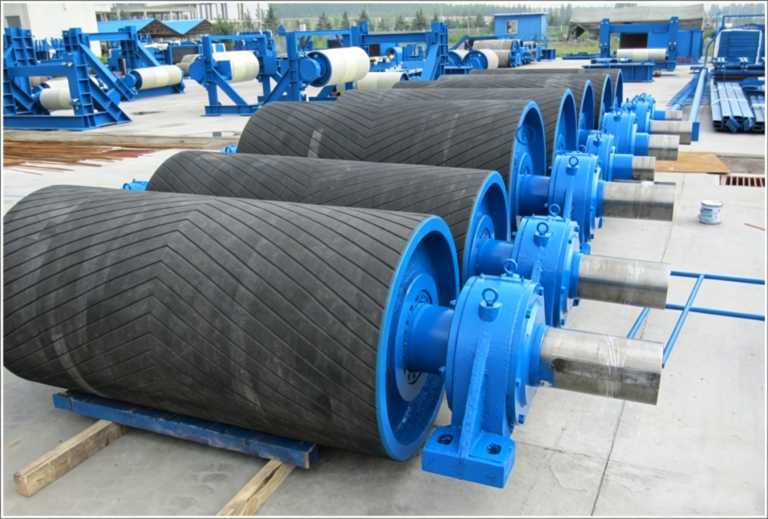
- Lagging Compound: Rubber, Ceramic, or Smooth Steel?
- Bearing Arrangement: External vs. Internal
- Take-Up Compatibility: Fixed, Screw, or Gravity?
- Tracking Support: Crowned Face or Self-Aligning?
- Solid Steel Tail Pulleys
- Wing Pulleys for Sticky Materials
Tail pulleys aren’t just passive wheels at the back of a conveyor. They determine belt tracking, tension control, and whether your material stays on the belt or ends up on the ground. When a tail pulley is undersized, misaligned, or built with the wrong lagging, the consequences show up fast: belt mistracking, edge damage, spillage, and unplanned downtime that eats into production targets.
Buyers chasing the lowest price on a tail pulley often overlook the specifications that actually keep a conveyor running: shell diameter, bearing arrangement, lagging compound, and take-up compatibility. Get these wrong, and you’re paying for belt replacement, cleanup labor, and repeated pulley swaps—costs that dwarf the pulley’s purchase price.
Haihui engineers emphasize belt-friendly diameter selection, lagging matched to site conditions, and take-up integration as the baseline for dependable tail pulley performance. Drawing on our experience manufacturing welded steel drum pulleys for bulk material handling across cement, power, mining, port, and steel industries, we build tail pulleys that keep belts centered and running smooth.
Harmonious Highlights for Tail Pulleys
➔ Diameter Logic: Size the tail pulley to the belt carcass and splice type—too small accelerates belt fatigue; too large wastes space and cost.
➔ Lagging Selection: Choose rubber, ceramic, or FRAS compounds based on wet, abrasive, or fire-risk conditions to prevent slip and protect the shell.
➔ Bearing & Take-Up Integration: Match bearing type, sealing, and take-up mechanism to the tension requirements and environmental conditions of the conveyor.
➔ Tracking Support: Specify crowned or flat face geometry and self-aligning features where belt wander is a recurring problem.
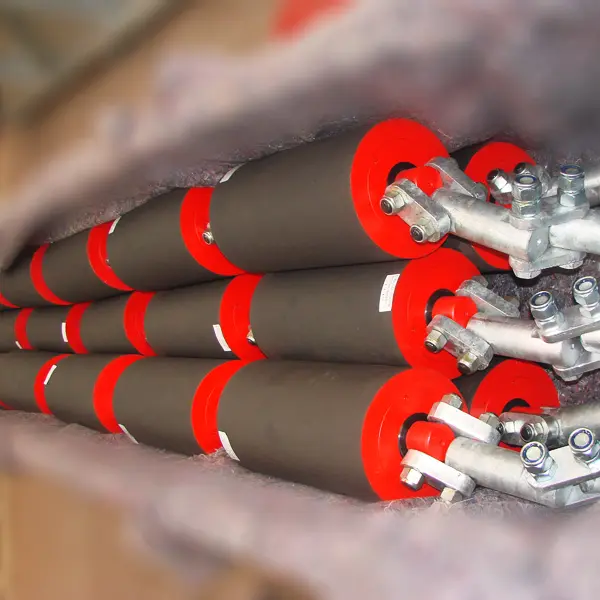
5 Factors To Check Before Ordering a Tail Pulley
When sourcing a tail pulley, small details make or break your conveyor’s reliability. Buyers chasing better pricing often overlook specs that affect belt life, tracking, and maintenance frequency. Here’s a practical breakdown to help you specify a tail pulley with confidence.
Diameter Selection: Match the Belt, Not the Budget
The tail pulley diameter directly affects belt bending stress and splice fatigue. A pulley that’s too small for the belt carcass causes delamination of belt layers and laceration of the reinforcing fabric. The minimum diameter depends on belt construction and carcass thickness.
Minimum tail pulley diameter recommendations based on belt type:
| Belt Type | Belt Tension (%) | Minimum Tail Pulley Diameter (mm) | Snub/Bend Pulley (mm) |
|---|---|---|---|
| Textile belt (light duty) | < 30% | 125 | 100 |
| Textile belt (standard) | < 50% | 200 | 160 |
| Textile belt (heavy duty) | > 60% | 250 | 200 |
| EP multi-ply | > 60% | 400 | 315 |
| Steel cord | > 60% | 500 | 400 |
Reference: Sempertrans minimum pulley diameter recommendations for textile and steel cord belts
For high-tension applications, a larger tail pulley diameter increases belt service life. The weaker the surface pressure on the pulley, the better the belt/pulley adhesion coefficient becomes. Never undersize a tail pulley to save space—the belt will pay for it.
Lagging Compound: Rubber, Ceramic, or Smooth Steel?
Lagging on a tail pulley serves two purposes: protecting the shell from wear and improving belt tracking. Unlike drive pulleys, tail pulleys don’t need maximum friction for torque transmission, but they do need enough grip to keep the belt centered.
Lagging selection by condition:
| Condition | Recommended Lagging | Pattern | Notes |
|---|---|---|---|
| Dry, clean, general bulk | Rubber | Plain or diamond | Standard choice |
| Wet, muddy, outdoor | Rubber | Herringbone | Directional; channels water |
| High abrasion, sharp ore | Abrasion-resistant rubber | Plain or grooved | Protects shell |
| Reversing conveyor | Rubber | Diamond | Non-directional |
| Fire-risk underground | FRAS compound | Plain or grooved | Safety requirement |
| Low-power, narrow belt | Smooth steel | None | Cost-effective for light duty |
Reference: Haihui tail pulley product specifications and industry lagging selection guides
Smooth steel tail pulleys suit conveyors with low power requirements and narrow belt widths. Herringbone rubber lagging offers excellent friction factor, anti-slip, and drainage ability. Diamond rubber lagging works for two-way operating conveyors .
Bearing Arrangement: External vs. Internal
Tail pulleys can be mounted with external bearings (bearing blocks on the conveyor frame) or internal bearings (bearings housed inside the pulley). The choice affects maintenance access, sealing, and cost.
| Bearing Arrangement | المزايا | Disadvantages | Best For |
|---|---|---|---|
| External bearings | Easy access for lubrication and replacement | Exposed to dust and moisture | Standard industrial conveyors |
| Internal bearings | Protected from environment; compact | Harder to inspect; requires pulley removal for service | Washdown, corrosive, or space-limited |
For dusty environments like cement plants or coal handling, external bearings with labyrinth seals are common. For washdown or corrosive applications, internal bearings with contact seals may be preferred.
Take-Up Compatibility: Fixed, Screw, or Gravity?
The tail pulley often serves as the take-up point on shorter conveyors. The take-up mechanism determines how belt tension is maintained and how the pulley is adjusted.
Take-up type comparison:
| Take-Up Type | Adjustment Method | Best For | Notes |
|---|---|---|---|
| Fixed | No adjustment; belt tension set by design | Short conveyors with stable load | Simplest; no field adjustment |
| Screw take-up | Manual adjustment via threaded rods | Short to medium conveyors | Requires periodic inspection |
| Gravity take-up | Automatic tension via weighted counterweight | Long conveyors, variable loads | Self-adjusting; needs space |
On short conveyors, the tail pulley often serves as the take-up pulley, providing tension on the belt . For longer conveyors, a separate take-up mechanism may be used, and the tail pulley simply redirects the belt.
Tracking Support: Crowned Face or Self-Aligning?
Belt mistracking at the tail pulley is a common problem. The pulley face geometry and alignment features determine how well the belt stays centered.
| Tracking Feature | How It Works | Best For |
|---|---|---|
| Flat face | No crown; relies on precise alignment | Well-aligned conveyors with stable loads |
| Crowned face | Slightly raised center encourages belt centering | Standard conveyors; mild mistracking |
| Self-aligning tail pulley | Pivots about a vertical axis to steer belt back | Conveyors prone to mistracking |
A self-aligning tail pulley uses a pivot mechanism to maintain the belt within a desired central region. When the belt shifts, a sensor detects the deviation and an actuator pivots the pulley support to increase tension on the side where the belt has drifted, steering it back to center .
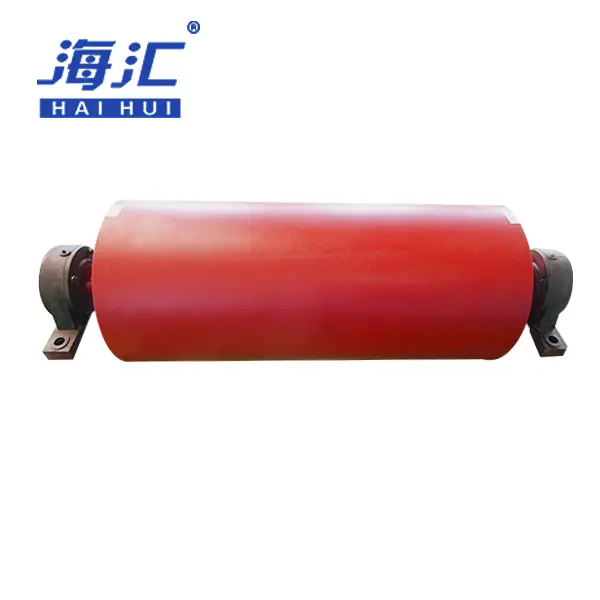
Steel Vs. Wing Tail Pulleys: Which To Choose?
Choosing between a solid steel tail pulley and a wing pulley isn’t just shop talk. If you’re sourcing a tail pulley, planning a transfer point, or comparing replacement options, the configuration shifts cost, lifespan, and maintenance frequency.
Solid Steel Tail Pulleys
Solid steel tail pulleys are the standard choice for most conveyor applications. They provide a smooth, flat surface for the belt to ride on, with predictable tracking behavior.
Key advantages:
- Smooth belt path; no bounce or oscillation
- Compatible with belt cleaning systems
- Simple to align and maintain
- Available with lagging for improved grip
Selection logic:
- Select shell diameter based on belt type and tension.
- Choose lagging compound and pattern for the environment.
- Confirm bearing arrangement and take-up compatibility.
- Verify face width matches belt width.
Solid steel tail pulleys are common in cement, steel, power, and port applications where belt stability is critical.
Wing Pulleys for Sticky Materials
Wing-type pulleys have vanes instead of a solid shell. Material that would otherwise cause blockages passes through the pulley face. The design is self-cleaning: the pulley’s rotation throws material off its surface.
Key advantages:
- Self-cleaning action reduces buildup
- Material passes through gaps instead of getting trapped
- Effective in spillage-prone areas
Limitations:
- Introduces oscillating action to the belt path
- Can destabilize belt sealing systems
- CEMA advises against wing pulleys on belts traveling over 225 m/min (450 ft/min)
- Larger lumps can lodge in the wings, potentially causing the damage the design is meant to prevent
Wing pulleys perform best on slow-moving belts where frequent cleaning and sealing are less critical. A superior alternative is the spiral-wrapped tail pulley, which adds a steel strip spirally wrapped around the circumference to cover the wings. This maintains the self-cleaning function while eliminating belt bounce .
Tail Pulley Specifications at Haihui
Haihui Environmental Protection Equipment Co., Ltd. is a manufacturer of belt conveyor pulleys, rollers, and structural components based in Rizhao, Shandong, China. The company operates 12 intelligent production workshops with an annual output capacity of 15,000 sets of equipment and holds 168 authorized patents, including 15 invention patents.
Product scope: welded steel drum pulleys, wing pulleys, head pulleys, tail pulleys, bend pulleys, and complete pulley assemblies for belt conveyors. Belt widths from 400 mm to 2,400 mm; pulley diameters from 200 mm to 1,600 mm. Materials include Q235 carbon steel and custom alloy steels for high-tension applications .
Quality systems: ISO 9001 certified. Products are manufactured to CEMA, AS, DIN, ISO, and GB standards .
Export markets: Products are exported to the United States, Russia, Canada, Australia, South America, the Middle East, and Southeast Asia .
Service capability: Professional sales team with 24-hour response, sample delivery in 1–2 days, OEM customization for products, logos, and packaging, and small-quantity order acceptance for urgent requirements.
FAQ about Tail Pulleys
Q: What is a tail pulley on a belt conveyor?
A: A tail pulley is the pulley located at the loading end of a belt conveyor. It redirects the belt back toward the drive pulley. On short conveyors, the tail pulley often serves as the take-up pulley, providing tension on the belt .
Q: What is the difference between a head pulley and a tail pulley?
A: The head pulley is at the discharge end and usually drives the belt. The tail pulley is at the loading end and redirects the belt. The head pulley is powered; the tail pulley is typically an idler pulley .
Q: What is the purpose of lagging on a tail pulley?
A: Lagging on a tail pulley protects the shell from wear and improves belt tracking. Unlike drive pulleys, tail pulleys don’t need maximum friction for torque transmission, but they do need enough grip to keep the belt centered .
Q: How do I choose the right lagging for my tail pulley?
A: Choose based on operating conditions. Smooth steel suits low-power, narrow-belt conveyors. Rubber lagging (herringbone or diamond) works for wet or abrasive conditions. FRAS lagging is required for fire-risk applications .
Q: What shaft material should I specify for a heavy-duty tail pulley?
A: EN19 (709M40) and 42CrMo (4140) are common choices for heavy-duty pulleys. EN19 offers allowable bending stress around 83 MPa, while 42CrMo can reach 90–100 MPa with appropriate heat treatment.
Q: What is the minimum tail pulley diameter for a given belt?
A: Minimum diameter depends on belt carcass material and thickness. Sempertrans data shows that for a standard textile belt with tension under 50%, a minimum tail pulley diameter of 200 mm is recommended. For heavy-duty EP belts over 60% tension, 400 mm is the minimum .
Q: Can a tail pulley serve as a take-up pulley?
A: Yes. On short conveyors, the tail pulley often serves as the take-up pulley, providing tension on the belt. Screw take-up or gravity take-up mechanisms can be integrated with the tail pulley .
Q: What is a self-aligning tail pulley?
A: A self-aligning tail pulley pivots about a vertical axis to maintain belt tracking. When the belt drifts, a sensor detects the deviation and an actuator pivots the pulley support to steer the belt back to center .
Q: When should I use a wing pulley instead of a solid tail pulley?
A: Wing pulleys suit sticky materials and spillage-prone areas. They are self-cleaning but introduce belt oscillation. CEMA advises against wing pulleys on belts over 225 m/min (450 ft/min). A spiral-wrapped wing pulley is a better alternative for higher speeds .
Q: Does Haihui manufacture tail pulleys for all conveyor applications?
A: Haihui manufactures tail pulleys for heavy-duty industrial conveyors in cement, mining, steel, power, port, chemical, and paper industries. We do not supply portable or light-duty conveyors used in warehouses or retail settings.
المراجع
- US Patent 7866462 B2 – Belt Type Conveyor Apparatus with Adjustable Tail Pulley. Adjustable tail pulley with pivot axis and actuator for belt centering.
- Martin Engineering – Wings Or Wraps [Tail Pulleys]? Wing pulley limitations, CEMA speed advisory, and spiral-wrapped alternative.
- Haihui – Conveyor tail pulley with hot vulcanized rubber lagging. Product specifications: belt width 400-2400mm, diameter 200-1600mm, Q235 carbon steel, CEMA/AS/DIN/ISO/GB standards.
- US Patent 4230222 – Grain conveyor assembly. Tail pulley shroud with paddles for material return, scraper bar, and deflector unit.
- US Patent 2916139 – Reversible belt training idler. Pivotal tail pulley mounting on vertical axis for lateral swinging movement.
- Bentley Systems – Tail Pulley Properties. Tail configuration options: Drive, Drive and Snubber, Pulley, Pulley and Snubber. Wrap angle definition.
- Haihui – Belt conveyor tail/bend pulley. Product specifications: Q235 carbon steel, belt width 400-2400mm, diameter 200-1600mm.
- Bossgoo – Take-up Pulley. Drive/Tail pulley categories: light duty, medium duty, heavy duty. Lagging options: smooth steel, herringbone, diamond.
- Sempertrans – Minimum Diameter of Pulleys. Minimum diameter tables for textile belts, EP multi-ply, and steel cord belts based on tension.
- Future Mining Expo – Haihui Environmental Protection Equip. Product range and export markets.
- MRO Supply – Conveyor Belt Pulleys. Head/drive pulley vs. return/tail pulley definitions. Tail pulley as take-up on short conveyors.
- US Patent 9776802 – Drive device for belt conveyor. Snub pulley and take-up pulley axial alignment with tail pulley.
- Haihui – Conveyor tail pulley product page (Italian version). Product specifications and standards.
- Rizhao Daily – Haihui Environmental overseas orders grow, production capacity utilization exceeds 95%.

 English
 العربية
 Português do Brasil
 Русский
 Español