New mobile elevating belt conveyor
Product Details
I. Overview:
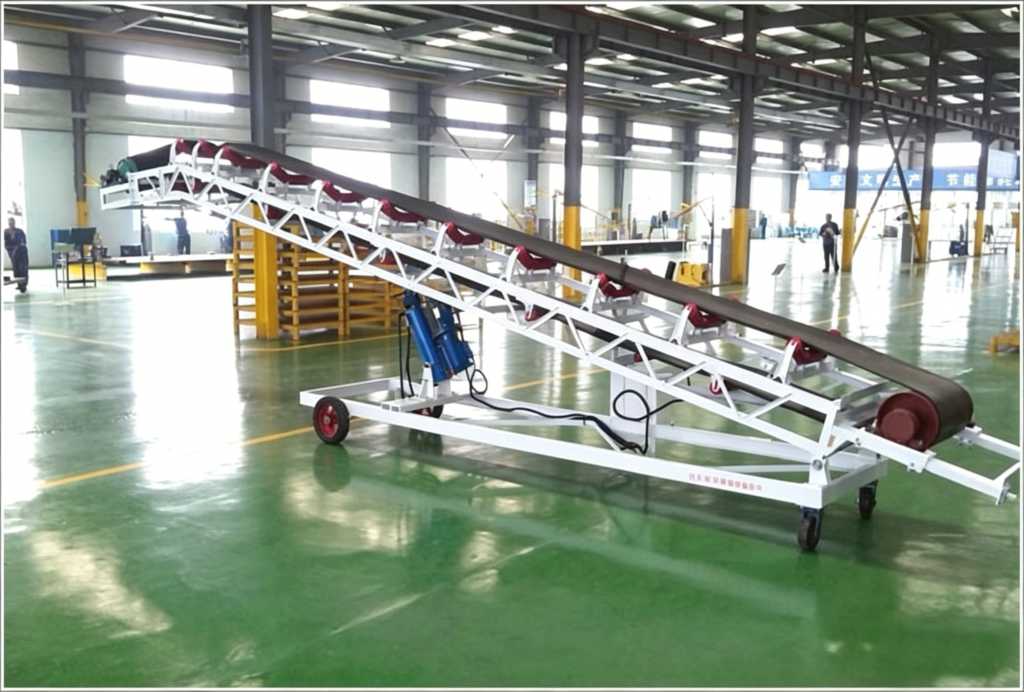
Mobile belt conveyors differ in design from traditional fixed conveyors. They are fitted with swivel castors at the base, allowing them to be moved freely according to the location of the material. The overall structure is lightweight and well-designed, and due to their excellent manoeuvrability, they are widely used for indoor and outdoor loading and transfer operations involving grain, bulk materials, light industrial goods and packaged items. The mobile conveyor comprises a main frame, running wheels, swivel castors and a lifting mechanism. The main frame is typically constructed from lightweight steel to reduce the unit’s weight and enhance the conveyor’s manoeuvrability and portability. The lifting mechanism is electrically operated, thereby reducing the risks and physical strain associated with manual lifting.
II. Features:
Key features of Haihui Group’s new mobile elevating belt conveyor: high load capacity, long service life, compact structure, small footprint and light weight. The mobile conveyor is suitable for any site, operating normally both indoors and outdoors. It offers excellent mobility; under normal circumstances, a single adult male can move it. With good manoeuvrability, it can be used directly for loading operations, material transfer and other applications, as well as for logistics loading and unloading tasks. Operation is straightforward; the unit is equipped with a control box containing a main power switch and a height adjustment switch. It operates unattended and is ready for use immediately upon start-up.
III. Equipment Performance
Key parameters are generally determined based on the requirements of the material handling system, the conditions at the loading/unloading site, relevant production processes, and the characteristics of the material:
- Conveying Capacity: The conveying capacity of conveyor equipment refers to the volume of material transported per unit of time. When conveying bulk materials, this is calculated as the mass or volume of material transported per hour; when conveying packaged goods, it is calculated as the number of items transported per hour.
- Conveying Speed: Increasing the conveying speed can enhance conveying capacity. In systems where a conveyor belt serves as the traction member and the conveying distance is considerable, conveying speed tends to increase. However, with high-speed belt conveyors, attention must be paid to issues such as vibration, noise, and start-up and braking. For conveyors used in conjunction with process operations, the conveying speed should be determined in accordance with production process requirements.
- Conveying length and inclination: The length of the conveying route and the degree of inclination directly affect the total resistance of the conveyor and the power required.